The package says it does not contain 7-OH. It may also say “alternative,” “compliant,” or “full spectrum.” For someone trying to leave a problematic product behind, those words can sound like a solution. For a family, they can create a difficult question: has the risk changed, or has the label changed while the same problems continue?
A claim that one ingredient is absent answers only one question. It does not identify every active compound, establish medical safety, or show that a person is no longer dependent. A replacement product should not be treated as a recovery plan simply because its front label names a different formula.
This guide examines newer alternative branding, including BARS products marketed with Mitraxidine™, and offers a practical way to evaluate claims without exaggerating what is known. It addresses parents, partners, and friends who are seeing repeated product switches, spending, impairment, or withdrawal concerns. Product information was reviewed November 6, 2026.
Key Points
- “7-OH-free” describes an ingredient claim, not proof of overall safety or freedom from dependence.
- Mitraxidine™ is presented by its manufacturer as a proprietary blend, not a single clearly defined chemical name.
- The reviewed BARS alternative page states that its formula excludes 7-OH, mitragynine pseudoindoxyl, MGM-15, and MGM-16. These are manufacturer claims, not independent confirmation by The Firm.
- BARS and Trance BARZ are different product names and should not be merged into one brand story.
- Rectangular tablets and “bars” language can evoke familiar pill imagery, but appearance alone does not prove intentional marketing to minors.
- Look at functioning across product changes: sickness when supply ends, repeated purchases, missed obligations, and failed attempts to stop.
- Medical assessment is more useful than choosing a new retail substitute or arguing over a slogan.
Alternative Blends at a Glance
| Label or claim | What it may tell you | What it does not establish |
|---|---|---|
| “7-OH-free” | The seller says one compound is absent. | Complete composition, absence of other psychoactive ingredients, or clinical safety. |
| Proprietary blend | The product uses a manufacturer-defined formulation. | The amount and effect of every individual active component. |
| Total milligrams | A stated weight for a tablet, serving, or blend. | Equivalent potency to the same number for a different drug. |
| Laboratory tested | Some analysis may be available. | That every batch and every possible substance were tested. |
| Age restriction | The seller states an intended purchase or use age. | That minors cannot access it or that adult use is safe. |
| “Legal” or “compliant” | A seller’s legal positioning. | Medical approval or current legality in every jurisdiction. |
What Is Being Sold as a 7-OH Alternative?
“Alternative” is not one drug category. It can refer to a different named compound, a revised mixture, or a proprietary formulation whose identity is described mostly through marketing. The first task is to determine which meaning applies to the actual package. Do not assume that every product using the term contains the same ingredient.
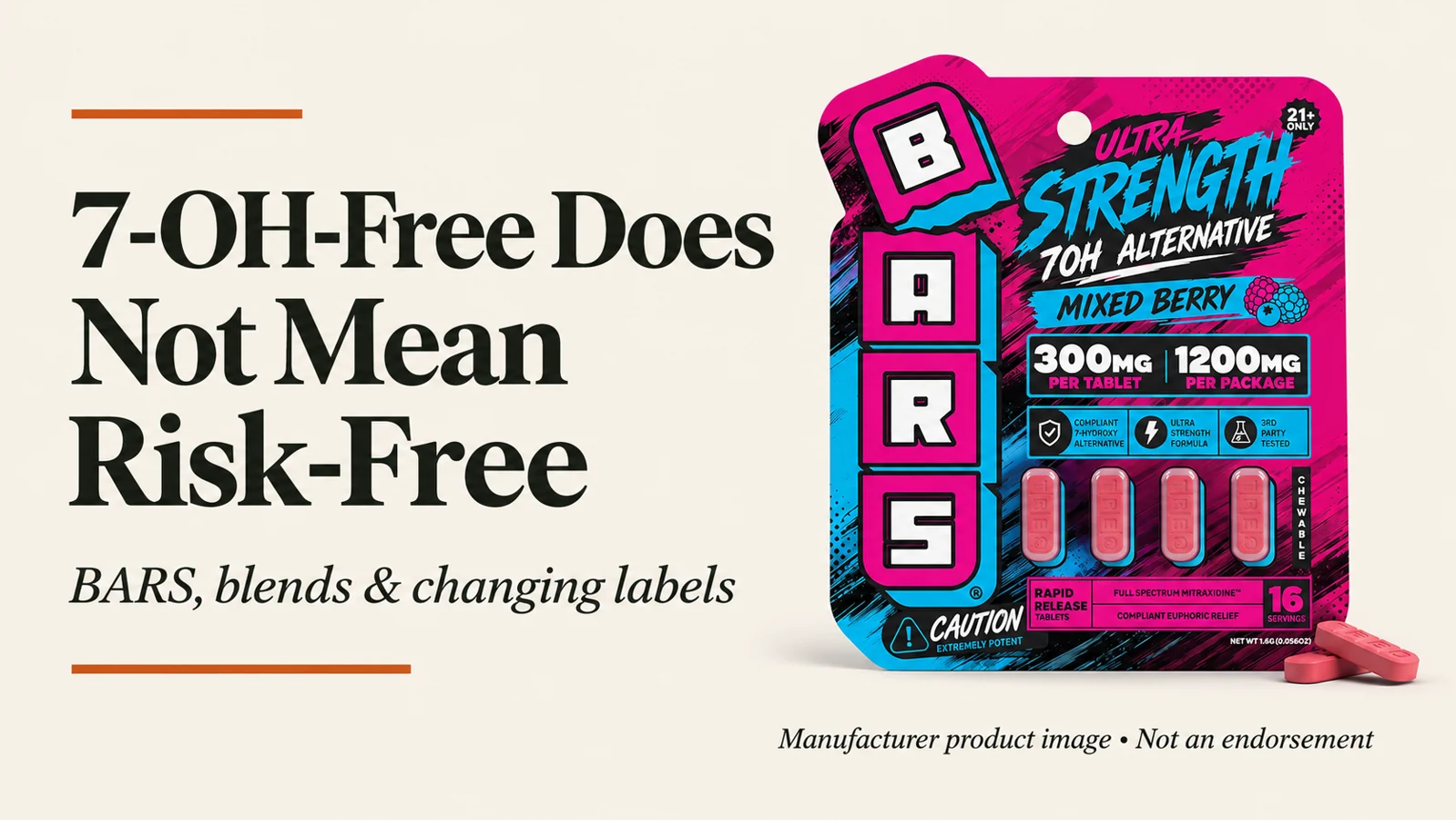
The BARS Mixed Berry alternative page reviewed for this article identifies Mitraxidine™ as a proprietary kratom-derived blend. It states that the formula contains no 7-OH, mitragynine pseudoindoxyl, MGM-15, or MGM-16 and warns of psychotropic effects. The page also carries an under-21 restriction. These statements document the seller’s description; they do not independently establish composition or safety. (Get Bars, n.d.-a)
A trademarked name can make a mixture sound like a standardized medicine. That impression needs to be checked against what is actually disclosed. If the individual active components are not clearly identified, a family should say so when seeking advice. There is no need to invent a chemical identity to make the concern sound more serious.
It would also be wrong to assert that a product secretly contains a prohibited compound without testing. Responsible criticism can focus on what is verifiable: the claims made, the information provided, the limits of the evidence, and the person’s real-world experience. That is enough to support a careful conversation.
BARS, BARZ, and the Familiar Xanax-Bar Association
Trance BARZ and Get Bars BARS are different examples. A publicly available report for a Trance BARZ sample shows round tablets. The BARS alternative product image reviewed here shows rectangular scored tablets. Conflating the names would make both product identification and the discussion of appearance less accurate. (Anresco Laboratories, 2025)
The rectangular shape and “bars” terminology can evoke some familiar alprazolam imagery and slang. That visual association is worth discussing, especially with a teenager who already recognizes benzodiazepine culture. It can make an unfamiliar product seem as though it belongs to a known category. It does not make the contents alprazolam or the effects equivalent.
We did not find evidence establishing that the manufacturer deliberately designed a campaign for teenagers. The stated age restriction should be acknowledged rather than omitted to strengthen a narrative. At the same time, an age warning does not answer every question about visual appeal or a young person’s interpretation of the product.
There is also no basis here for claiming that teenagers generally start with benzodiazepines and then move to these blends. If a particular young person has that history, it is important to disclose it. An individual history should not be turned into an unsupported population-wide progression.
A useful question is, “What did you think this was when you first saw it?” Follow with, “What did you expect it to do?” Those questions may reveal mistaken assumptions that a lecture about packaging would miss. They also keep the conversation focused on the person rather than on proving a brand’s intentions.
How Marketing Can Make Risk Harder to See
Flavor names, bright colors, convenience, and promises of strong effects can sit beside warnings in the same presentation. A person may remember the promised benefit more clearly than the limitation. Families can examine that tension without assuming that every buyer is naïve or that every design choice has a hidden motive.
The key distinction is between a marketing claim and clinical evidence. A testimonial about relaxation does not show how a product performs in a controlled trial, what happens with repeated use, or how it interacts with a person’s medications. A review may describe one person’s experience, but it cannot establish a dependable outcome for another.
Similarly, a seller’s claim about legal compliance is not a health assessment. Legal status, product quality, and individual suitability are different questions. Even a technically accurate statement about one of them cannot answer the other two. Avoid letting the conversation collapse into “If it were dangerous, they could not sell it.”
Ask the person what evidence they relied on. Was it a friend, a store employee, a review, or a laboratory report? Understanding the source of reassurance helps the family respond specifically. It is more productive than dismissing everything they have read and inviting a defensive debate.
Reading a Label Without Turning It Into a Dosing Guide
Start with the product name, version, ingredient list, serving information, and lot number. Photograph them together. A front panel may emphasize a large number while the detailed panel describes that number as a total blend weight. Those are not automatically the same thing as an amount of one active drug.
Do not compare milligrams across unlike substances as though the numbers describe equal effects. A total for a proprietary mixture cannot be reliably converted into an amount of 7-OH, alprazolam, or another compound. The same caution applies when one package counts per tablet and another counts per serving or per container.
The purpose of collecting label information is to help professionals understand the reported exposure. It is not to calculate a better way to continue using. If someone is seeking a substitute to avoid sickness, that concern belongs in an assessment of dependence and withdrawal.
Keep older package photographs if a formula changes. A person may refer to every version by the same short name even though the label has changed. A dated sequence can help distinguish what was used before symptoms began from what is being used now.
What a Certificate of Analysis Can Really Tell You
A certificate of analysis can be useful, but it answers the questions that were actually tested. Look for a matching product, lot, date, laboratory, and list of analytes. A report for a different batch or a narrow set of compounds is not a complete description of the package in your hand.
The manufacturer provides a page of reports for the reviewed alternative product. This article cites that page as a disclosure source, not as a clinical endorsement or a claim that The Firm independently tested the product. Readers should distinguish access to a report from a conclusion that the product has been proven safe. (Get Bars, n.d.-b)
| Question to ask | Why it matters |
|---|---|
| Does the lot match? | A report from another batch may not describe this package. |
| What was tested? | A negative result only addresses substances and methods within the stated scope. |
| What does “not detected” mean? | It depends on the method and reporting limit; it is not a claim about every possible ingredient. |
| Who supplied the sample? | Sampling and chain of custody affect what can be generalized. |
| Is there human safety evidence? | Composition testing is different from a clinical study. |
| Does the report answer the family’s concern? | It may not explain impairment, withdrawal, or interactions. |
If the person uses a laboratory badge to dismiss every concern, return to functioning. Even a correctly identified substance can be inappropriate or harmful in a particular situation. A report does not invalidate missed work, repeated sickness, or inability to stop.
What the Data Say About the Broader Market
Broader kratom-related surveillance provides context, but it cannot be used as a brand-specific risk estimate. A CDC-published study reported an increase from 258 kratom-related poison-center reports in 2015 to 3,434 in 2025. Most reports involved adults ages 20–39. Those figures concern a broader category, not Mitraxidine or BARS alternative products specifically. (Towers et al., 2026)
| Evidence question | Current answer in this review | Limit |
|---|---|---|
| Is there a broader public-health signal? | Kratom-related poison-center reports increased substantially over 2015–2025. | The category combines products and cannot isolate this blend. |
| Are teens proven to be the main users? | No brand-specific population estimate was identified. | Packaging observations cannot substitute for age-specific data. |
| Has this proprietary blend been shown safe in clinical trials? | No such evidence was identified in the sources reviewed. | That is an evidence gap, not proof of a particular undisclosed ingredient. |
| Can family observations justify assessment? | Yes: impairment, repeated use despite harm, or difficulty stopping are practical concerns. | A clinician, not a family checklist, makes the diagnosis. |
The distinction protects readers from two errors. One is assuming the lack of product-specific statistics means the product is harmless. The other is borrowing the most dramatic numbers from a different substance and presenting them as this brand’s outcomes. Neither helps a family make a clear decision.
A responsible assessment can proceed while some composition questions remain unanswered. Tell the provider what is known, bring the package, and describe the pattern. Uncertainty is information to communicate, not a reason to postpone help indefinitely.
Has the Product Changed or Has the Problem Changed?
Consider the weeks before and after a switch. Has the person become more reliable at work or school? Are they spending less time obtaining products? Are they more alert? Can they get through ordinary activities without planning around access? A change that improves functioning should be described honestly; a change that leaves the same harms in place should also be acknowledged.
Ask what happens when the new product is unavailable. If the answer involves feeling sick, being unable to function, or urgently seeking another substitute, the family needs guidance about possible dependence. Do not respond by finding a more convenient source or another product that promises a similar effect.
Keep the discussion grounded in a few observations. “You said the new formula would solve this, but you missed work twice after running out” is clearer than “You are just replacing one addiction with another.” The first invites an assessment of facts; the second may trigger a dispute over labels.
People may feel ashamed that an attempted solution has not worked. Make room for that without minimizing harm. Acknowledging effort can help the person accept a different kind of help: a clinician’s assessment rather than another purchase.
When to Seek Medical Help
Call 911 if someone cannot be awakened, has slow or abnormal breathing, is having a seizure, or appears critically ill. If opioid overdose is suspected, administer available naloxone according to its instructions and follow dispatcher guidance. Stay with the person and obtain emergency care even if they improve. The exact product does not need to be identified before emergency action. (Centers for Disease Control and Prevention [CDC], n.d.)
For a possible exposure without immediate life-threatening symptoms, U.S. Poison Control is available at 1-800-222-1222. Seek prompt advice for children. Do not make the person vomit or give another substance to offset the effects. Provide the package when possible without delaying care.
For ongoing difficulty stopping, arrange an assessment and explain the full product history. Include alcohol, prescribed medications, and nonprescribed pills. Do not independently stop an established benzodiazepine prescription: abrupt withdrawal can be dangerous. (U.S. Food and Drug Administration [FDA], 2020)
Building a Family Response Beyond the Next Product
A useful plan addresses the person’s needs as well as the product. If they are trying to manage pain, anxiety, sleep problems, or withdrawal, ask how those concerns will be assessed. Removing a packet without addressing the reason for use can leave the person looking for the next advertised solution.
Choose a conversation time when everyone can participate safely. Agree beforehand on the main observations, the offer of assessment, and the boundaries each family member controls. Avoid a surprise confrontation during intoxication or severe distress. An urgent medical problem calls for care, not a rehearsed family meeting.
Offer practical help with appointments, transportation, childcare, or questions about treatment options. For a teenager, involve appropriate caregivers and adolescent professionals. For an adult, be clear about support and limits while respecting their decision-making. Do not ask siblings to become investigators or monitors.
The Firm’s gas-station drug intervention services and family coaching can help organize the response. Treatment placement guidance can support comparison of appropriate care options. Medical assessment and emergency services remain essential when symptoms require them.
For more detail on named substances, read our guides to 7-OH, tianeptine, mitragynine pseudoindoxyl, and MGM-15 and MGM-16. The goal is to help families recognize the changing landscape without treating the next label as the answer.
A Practical Conversation About a New Formula
When someone brings home a replacement product, start by asking them to explain the change in their own words. What was wrong with the old product? What do they expect the new one to solve? What information made them trust it? Listening first can reveal whether the decision was about avoiding withdrawal, chasing effects, managing pain, or simply responding to a seller’s recommendation.
Then separate three questions: what the label claims, what the person experiences, and what a qualified clinician can assess. The label may say that one ingredient is absent. The person may report that they feel better. Neither statement alone establishes that the broader problem has been resolved. Keeping the questions separate prevents a single reassuring detail from carrying too much weight.
Use a specific example of the remaining concern. “You are still leaving work to buy more” is easier to discuss than “This is obviously just another bad product.” Ask what would count as meaningful improvement for both of you. Reliable attendance, safer behavior, and willingness to obtain advice are more useful discussion points than a promise never to make another mistake.
Avoid requiring the person to admit that every decision was wrong before you offer help. Someone can accept an assessment while still feeling attached to their explanation. The appointment is where uncertainty can be explored more carefully. A family conversation does not have to settle every scientific or legal disagreement first.
If the discussion becomes heated, pause rather than increasing the number of accusations. Return to the specific offer and the boundaries you control. If there is immediate danger, move to the appropriate safety response. A planned intervention should not continue as though it were an ordinary conversation when medical instability or threats change the situation.
Afterward, write down the agreed next step, who will arrange it, and when you will check back. Keep that follow-up focused on whether help was reached and what barriers arose. Repeatedly demanding updates about every feeling or thought can turn support into surveillance and make honest communication harder.
For families who cannot agree on the approach, outside guidance can help clarify roles before another conversation. The aim is a coherent offer of care and sustainable boundaries, not a more forceful argument about which packet is worst.
Frequently Asked Questions
Does 7-OH-free mean a product cannot cause problems?
No. It is an ingredient claim, not a complete safety assessment. Other ingredients, interactions, use patterns, and the person’s health still matter.
What is Mitraxidine?
The manufacturer describes Mitraxidine™ as a proprietary kratom-derived blend. It should not be treated as the name of one independently characterized drug solely because it is trademarked.
Does BARS alternative contain MGM-15 or pseudoindoxyl?
The reviewed manufacturer page says it excludes those compounds, along with 7-OH and MGM-16. The Firm has not independently tested the product and does not claim otherwise.
Are BARS and BARZ the same company or product?
They should not be treated as the same product. This series distinguishes Get Bars BARS from the Trance BARZ sample documented in a separate laboratory report.
Do bar-shaped tablets prove teen targeting?
No. Their resemblance to familiar pill imagery can be discussed, but manufacturer intent and teen-specific use require evidence beyond appearance. The reviewed seller also states an under-21 restriction.
Can a family compare products by the milligram number?
Not reliably across different compounds and blends. A total blend weight is not the same as an amount of one active drug, and unlike substances are not interchangeable by weight.
What if the person says the new formula fixed everything?
Look together at functioning, spending, impairment, and what happens when supply ends. If problems persist, offer a professional assessment rather than debating the slogan.
How do we get help planning the conversation?
Contact The Firm or call 877-FIRM-910 for help organizing family next steps. Call 911 for a medical emergency.
References
Anresco Laboratories. (2025, July 30). Report of analysis: Trance Barz 30 mg Blue Raspberry tablet (Sample 1323159). TestMyKratom.org. Laboratory report.
Centers for Disease Control and Prevention. (n.d.). About naloxone. Retrieved November 6, 2026, from CDC overdose prevention.
Get Bars. (n.d.-a). BARS 7OH-alternative tablets: Mixed berry. Retrieved November 6, 2026, from Manufacturer product page.
Get Bars. (n.d.-b). Lab reports for 7OH-alternative tablets: Mixed berry. Retrieved November 6, 2026, from Manufacturer report index.
Ingham, J. (2026, November 18). Cat’s claw or 7-OH in disguise? What Tennessee needs to know about mislabeled opioid products. Brooks Healing Center. https://brookshealingcenter.com/blog/cats-claw-7-oh/
Towers, E. B., Thomas, Y. T., Holstege, C. P., & Farah, R. (2026). Increases in kratom-related reports to poison centers: National Poison Data System, United States, 2015–2025. Morbidity and Mortality Weekly Report, 75(11), 139–145. CDC research report.
U.S. Food and Drug Administration. (2020, September 23). FDA requiring boxed warning updated to improve safe use of benzodiazepine drug class. Drug safety communication.
Educational information, not a product recommendation or individualized medical advice. Manufacturer material is cited to document claims and appearance, not to validate safety or endorse purchase.