
A family may finally learn what 7-OH is, only to find a different abbreviation on the next package: MGM. The person using it may explain that the old product is unavailable, that this one is newer, or that it is a workaround for changing rules. What the family needs to know is whether the change reduces harm, continues dependence, or introduces additional uncertainty.
MGM-15 and MGM-16 are distinct opioid-active compounds associated with the expanding kratom-derived drug discussion. They should not be treated as ordinary product flavors or as interchangeable versions of a familiar supplement. At the same time, evidence about one should not be automatically transferred to the other.
This guide explains the names, the evidence behind concern, and a practical family response. It does not provide dosing comparisons or recommend a replacement drug. Product and regulatory information was checked November 6, 2026.
Key Points
- MGM-15 and MGM-16 are different compounds, not two strengths of the same verified consumer product.
- MGM-15 has been documented in the commercial market. Evidence reviewed here does not establish widespread consumer availability of MGM-16.
- Preclinical opioid activity and emerging clinical reports justify concern, but they do not establish a reliable population risk estimate.
- DEA temporarily placed both compounds in Schedule I effective August 26, 2026.
- A submitted sample or laboratory report can establish limited facts about that sample, not safety across a brand.
- A switch from 7-OH to a new product may leave the same dependence and functional problems in place.
- Families should prioritize symptoms, honest disclosure, and assessment over attempting a home conversion or taper.
MGM-15 and MGM-16 at a Glance
| Question | Practical answer |
|---|---|
| What is MGM-15? | A chemically modified kratom-related opioid compound also described as dihydro-7-hydroxymitragynine. |
| What is MGM-16? | A different, fluorinated related compound. The similar numbering does not mean equivalent effects. |
| Are both established retail products? | MGM-15 has documented commercial examples. The evidence reviewed does not establish widespread MGM-16 retail use. |
| Are they approved medicines? | No accepted medical use in the United States was identified in the federal materials reviewed. |
| What is the federal status? | Both are covered by the temporary Schedule I order effective August 26, 2026. |
| What matters in an assessment? | The actual package, product changes, current symptoms, use pattern, other substances, and medical history. |
| What should families avoid? | Assuming a new name is safer, calculating equivalent amounts, or managing withdrawal from online anecdotes. |
Understanding the Names Without Losing the Main Point
DEA identifies MGM-15 as dihydro-7-hydroxymitragynine and MGM-16 as a fluorinated related compound. Its August 2026 order describes their opioid activity and temporarily places them, together with mitragynine pseudoindoxyl, in Schedule I. These names identify distinct chemical structures; they are not a simple consumer rating system. (Drug Enforcement Administration [DEA], 2026a)
A parent does not need to memorize chemical nomenclature to ask a useful question. “What exact product are you taking now?” is a better starting point than “Is this just kratom?” Photograph the packaging and keep any lot information. If the person uses the shorthand “MGM,” make clear to clinicians that the precise identity has not been confirmed.
The distinction between names matters most when someone begins making comparisons. A statement that one compound has a particular property does not establish the same property for another. Nor does the presence of a familiar word in the name establish that the finished retail product behaves like a traditional leaf preparation.
Families can be both precise and direct: these are products that warrant serious assessment, and a complicated name is not a reason to postpone help. If the person is impaired or becoming sick between uses, those observations already provide a concrete basis for concern.
MGM-15 Versus MGM-16: What Is Actually Documented?
| Issue | MGM-15 | MGM-16 |
|---|---|---|
| Identity | Dihydro-7-hydroxymitragynine. | A fluorinated related compound with a different structure. |
| Market evidence reviewed | Commercial product testing and regulatory documentation. | Emerging concern and vendor discussion in federal materials; not evidence of widespread retail use. |
| Human evidence | Emerging clinical literature, including a recent case-series publication involving 7-OH and MGM-15. | Insufficient evidence here to characterize ordinary consumer outcomes. |
| Federal action | Temporary Schedule I order effective August 26, 2026. | Covered by the same effective order. |
| Family implication | Take reported exposure seriously and obtain individualized assessment. | Do not confuse lack of consumer data with demonstrated safety. |
The market distinction is important. It would overstate the evidence to tell every parent that MGM-16 is already a common gas-station purchase. The federal assessment described MGM-15’s emergence while distinguishing the more limited evidence of MGM-16 in the consumer market. We retain that distinction rather than presenting both as equally widespread.
A 2026 case-series publication discusses community paramedics’ response to dependence involving 7-OH and MGM-15. Such reports can alert clinicians to emerging problems and care needs. A case series cannot measure how often a substance is used nationally or establish that one treatment approach will fit every patient. (Gormley et al., 2026)
For families, the practical question is not whether a product has become popular enough to deserve concern. It is whether the person in front of them is struggling. New compounds can create real individual problems before there is a large population study or a familiar diagnostic shortcut.
A Real Product Report and Its Limits
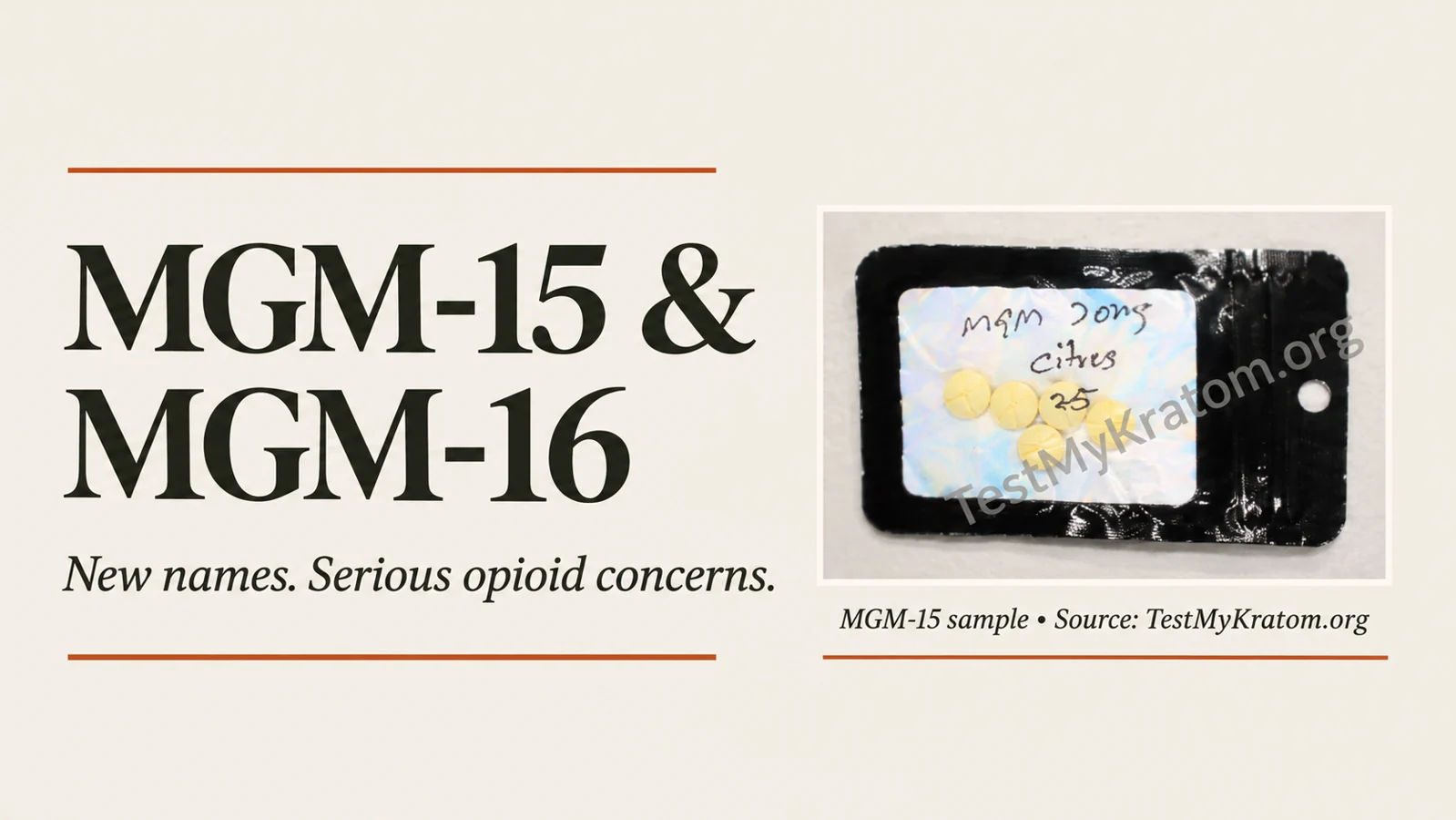
A publicly available NN Analytics report dated March 7, 2026 identifies a submitted Powder Solutions MGM Citrus tablet sample and reports MGM-15 in it. The accompanying sample photograph is the documentary product example used in this article’s featured graphic. The report is evidence about that submitted sample, not every tablet sold under a similar description. (NN Analytics, 2026)
A laboratory report should be read with its scope in mind. The sample description, lot, date, analytical method, and limitations matter. A result for a named substance does not automatically show that every possible contaminant was tested. An accreditation logo also does not necessarily mean that every method in a report falls within the laboratory’s accredited scope.
Families do not need to become laboratory auditors, but they should avoid turning “lab tested” into “medically safe.” Testing can answer selected composition questions. It cannot determine whether a person with particular health conditions, prescriptions, or a history of dependence should take the product.
Keep the report with the actual package if one is available. Do not download a report for a different flavor or batch and assume it applies. If the label and report do not match, tell the clinician about that uncertainty instead of filling the gap with a guess.
How to Read Emerging-Drug Data Responsibly
| Information available | Useful interpretation | Unsupported conclusion |
|---|---|---|
| One commercial sample | A compound was identified in the tested material. | Every product from that brand has identical contents. |
| A case series | Clinicians have encountered cases worth reporting. | A population-wide addiction or overdose rate is known. |
| Preclinical opioid findings | There is a biological basis for concern and further study. | A precise human potency or safety comparison is established. |
| Broader kratom reports | The larger category has generated public-health concern. | Those numbers are MGM-specific statistics. |
| No teen-specific estimate | The surveillance evidence has a gap. | Teenagers are unaffected or are proven to be the main users. |
A table without dramatic prevalence percentages may feel less satisfying than a headline claiming an epidemic of a particular new compound. It is more honest when the data are limited. This article does not assign a national user count, teenage prevalence, or overdose probability to MGM-15 or MGM-16 because the reviewed sources do not support those figures.
What families can do is combine the available evidence with specific observations. If a teenager is using an unidentified product, that merits attention regardless of the national rate. If an adult is missing work, spending heavily, or unable to go without a product, the absence of a large study does not make those consequences disappear.
Try to keep uncertainty visible without letting it become paralysis. “We do not know the precise contents, and we need medical advice” is a complete and reasonable statement. It is more useful than either assuming the worst possible formulation or assuming that a product must be safe because information is scarce.
Why Switching From 7-OH May Not Solve Dependence
A person may change products for price, availability, legal concerns, or the hope of avoiding withdrawal. The switch can be sincerely intended as progress. The family should acknowledge that intention while asking whether the person’s daily life has actually improved.
Look at the pattern across labels. Is the person still leaving events to obtain more? Are mornings difficult until they use? Are they increasingly anxious about deliveries or store stock? Are they continuing despite relationship, financial, or work consequences? These observations help define the problem without relying on a brand name.
Ask what happened during the last attempt to stop. The answer may reveal physical symptoms, untreated pain, distress, or fear that needs professional attention. Avoid responding with a schedule built from forum posts or a recommendation for another retail product. The actual contents and the person’s health may be uncertain.
Our guides to 7-OH, mitragynine pseudoindoxyl, and proprietary alternative blends explain related distinctions. They are intended to support recognition and assessment, not to rank replacement products.
Brands, Bar Shapes, and the Limits of Appearance
Names and packaging can create familiarity around a substance a person does not understand. A scored tablet, a flavor, or a reference to “bars” may evoke another drug category. That association is worth discussing with a young person, especially if they already recognize benzodiazepine slang or imagery.
It does not follow that every rectangular tablet contains a benzodiazepine, or that every brand with a similar name has the same formulation. Trance BARZ and Get Bars BARS are separate examples discussed elsewhere in this series. A product photo should be used to identify that example, not as a universal pill-identification system.
We also cannot establish a deliberate teen-targeting campaign from appearance alone. A direct conversation can still ask the important questions: what did the person think they were buying, what effect were they seeking, and did they combine it with anything else? Those answers are more useful for care than an unsupported claim about a manufacturer’s intentions.
Medical Safety and Combined Substance Use
If someone cannot be awakened, has slow or abnormal breathing, is having a seizure, or appears critically ill, call 911. Give available naloxone as directed when opioid overdose is suspected and follow emergency-dispatch instructions. Do not leave the person alone or assume that improvement eliminates the need for emergency evaluation. (Centers for Disease Control and Prevention [CDC], n.d.)
Provide the package if it is safe to do so, but do not delay while looking for it. Tell responders about all known substances and prescriptions. An uncertain product name is not a reason to withhold the information you do have. Do not give another substance to counteract the effects or attempt to induce vomiting.
For a non-emergency possible exposure, U.S. Poison Control is available at 1-800-222-1222. Seek prompt advice for a child’s possible ingestion even if symptoms are not yet obvious. Secure products away from children and pets while following professional guidance.
Alcohol and benzodiazepines deserve explicit discussion because combining opioid-active substances with other depressants can create serious breathing and sedation concerns. Do not independently stop an established benzodiazepine prescription; withdrawal can itself be dangerous. Medical professionals need to coordinate the whole medication and substance picture. (U.S. Food and Drug Administration [FDA], 2020)
Preparing for Treatment Without Promising a Quick Fix
Start with an assessment that can address opioid-related dependence, medical stability, and co-occurring needs. Ask who will conduct the evaluation and how the service handles unfamiliar or uncertain retail products. If the first provider cannot offer the needed expertise, ask for a referral rather than assuming the only remaining option is home management.
Bring a timeline that includes earlier products and changes. A person may remember the latest package but overlook the months of use that preceded it. Include prior treatment, overdose concerns, attempts to stop, prescribed medications, and what the person hopes will improve. These details help a clinician consider the whole situation.
Evidence-based medications are available for opioid use disorder, but their use requires an individualized clinical assessment. This article does not establish a specific treatment protocol for MGM compounds. Ask whether appropriate medication care is available or can be coordinated, along with counseling and practical support. (Substance Abuse and Mental Health Services Administration [SAMHSA], 2021)
Make the logistics concrete. Transportation, childcare, time away from work, payment questions, and communication with existing clinicians can derail a willing person. A family member can help with these tasks without taking on the role of prescriber or round-the-clock monitor.
A Family Plan for Acceptance or Refusal
Before a planned conversation, agree on a few observable concerns and one clear next step. A family can say, “The products keep changing, but the sickness and spending are continuing. We want to help you get assessed.” This avoids arguing over whether one packet is technically better than another.
If the person agrees, move toward the arranged appointment and clarify what happens after it. If they decline, keep the offer understandable and maintain boundaries you can follow. Do not threaten consequences that create new safety risks or that family members privately intend to reverse.
For a minor, involve appropriate caregivers and qualified adolescent services. For an adult, respect their decision-making while addressing safety around driving, children, and shared responsibilities. Relatives should not ask younger family members to investigate purchases or supervise an impaired person.
The Firm’s gas-station drug intervention services can help organize a family response. Family coaching, treatment placement guidance, and case management may help connect the conversation to practical follow-through. These services do not replace emergency treatment or medical withdrawal management.
Different Ages, Different Practical Concerns
The lack of reliable MGM-specific age statistics does not mean that families should respond identically at every life stage. A teenager, a college student, a working parent, and an older adult may face different barriers to help. These are practical considerations for planning, not claims that one age group is more likely to use MGM products.
Teenagers and younger family members
For a teenager, ask who is providing access and what the young person believes the product contains. Involve qualified adolescent care and appropriate caregivers. School concerns may need attention, but public discipline should not replace a medical assessment. Avoid treating a package discovery as proof that every friend is involved or that the teenager has disclosed the complete picture immediately.
Protect siblings from being assigned a monitoring role. They should not be expected to search rooms, report every movement, or decide whether an impaired person needs medical help. Give them a simple route to a responsible adult and keep detailed treatment planning with the adults and professionals involved.
College-age and working adults
An adult may worry that seeking care will disrupt school, employment, or housing. Ask the provider about realistic scheduling and documentation needs without promising confidentiality or employment protections you cannot guarantee. Help the person identify what can be arranged now and what requires professional advice.
Financial dependence can complicate family boundaries. Paying directly for an assessment or transportation may be more manageable than unrestricted money, but the right arrangement depends on the household. Be explicit about the offer and avoid changing it repeatedly in the middle of conflict.
Parents and older adults
If the person cares for children or another dependent adult, make a safe backup plan for times of impairment or treatment. The plan should identify an actual responsible person rather than assume someone will be available. Do not allow the need to keep daily life running to become a reason for ignoring urgent symptoms.
For an older adult, bring a complete medication list and relevant medical history to the assessment. Do not assume a new change in alertness or functioning is simply aging, and do not assume it is necessarily caused by the suspected product. A clinician needs to evaluate the possibilities.
Across ages, the family’s role is to make appropriate help reachable while communicating accurately. Avoid generic predictions based on age alone. The person’s current symptoms, responsibilities, preferences, and assessed needs should guide the next step.
Revisit the plan after the first appointment. Ask whether practical arrangements worked and whether additional support is needed. A plan that was reasonable on paper may need adjustment once transportation, work, or caregiving demands become clear. Those adjustments are part of follow-through, not evidence that the family failed.
Choose one person to coordinate practical updates when several relatives are involved. This can reduce duplicate calls and conflicting messages while preserving the adult patient’s consent and privacy. Coordination should make care easier to reach; it should not create a family committee that attempts to overrule clinical recommendations.
Frequently Asked Questions
Are MGM-15 and MGM-16 the same drug?
No. They are distinct compounds. Similar names do not establish equivalent effects, interchangeable amounts, or the same evidence base.
Is MGM-16 already common in stores?
The evidence reviewed does not establish widespread consumer availability. MGM-15 has documented commercial examples; MGM-16 should be described more cautiously as an emerging concern.
Are these substances federally controlled?
As checked November 6, 2026, both are covered by DEA’s temporary Schedule I order effective August 26, 2026. Later proposals do not automatically cancel an existing order.
Does a lab-tested product eliminate risk?
No. Testing can address specified questions about a submitted sample. It does not establish clinical safety, verify every package, or determine suitability for an individual.
Can someone use MGM-15 to get off 7-OH?
A retail substitution is not an established treatment plan. A clinician should assess dependence and appropriate care rather than relying on a product-to-product conversion.
How many teenagers are using these compounds?
A reliable national teen-specific estimate was not identified for this article. We do not substitute broader kratom statistics for MGM-specific data.
What should I bring to an appointment?
Bring the actual packaging or clear photographs, lot information, a timeline of product changes, symptoms, attempts to stop, and a complete medication and substance history.
How can The Firm help our family?
The Firm can help plan a family conversation and coordinate appropriate next steps. Contact the team or call 877-FIRM-910. Call 911 for medical emergencies.
References
Centers for Disease Control and Prevention. (n.d.). About naloxone. Retrieved November 6, 2026, from CDC overdose prevention.
Drug Enforcement Administration. (2026a, August 26). Schedules of controlled substances: Temporary placement of mitragynine pseudoindoxyl, MGM-15, and MGM-16 in Schedule I. Federal Register, 91, 54948–54956. Temporary scheduling order.
Drug Enforcement Administration. (2026b, October 14). Schedules of controlled substances: Temporary placement of MGM-15 and MGM-16 in Schedule I [Notice of intent]. Federal Register notice.
Gormley, M. A., Wampler, W. R., Darby, T., Mann, D., McElmurray, K., Brophy, B., Elkes, J., Beltran, G. W., Litwin, A. H., & Fabiano, S. (2026). Community paramedics addressing the evolving opioid crisis: A case series addressing the kratom derivatives 7-hydroxymitragynine and MGM-15. Prehospital Emergency Care. Advance online publication. https://doi.org/10.1080/10903127.2026.2753000
Ingham, J. (2026, September 28). MGM-15: What to know about this new kratom-derived opioid. Brooks Healing Center. https://brookshealingcenter.com/blog/synthetic-opioid-mgm-15/
NN Analytics. (2026, March 7). Report of analysis: Powder Solutions 20 mg MGM Citrus tablet (Sample 2603-021). TestMyKratom.org. Laboratory report.
Substance Abuse and Mental Health Services Administration. (2021). Medications for opioid use disorder (Treatment Improvement Protocol 63). Treatment guidance.
U.S. Food and Drug Administration. (2020, September 23). FDA requiring boxed warning updated to improve safe use of benzodiazepine drug class. Drug safety communication.
Educational information, not an individualized medical or legal assessment. The product photograph documents an MGM-15 sample; it does not depict a verified MGM-16 retail product or endorse use.