
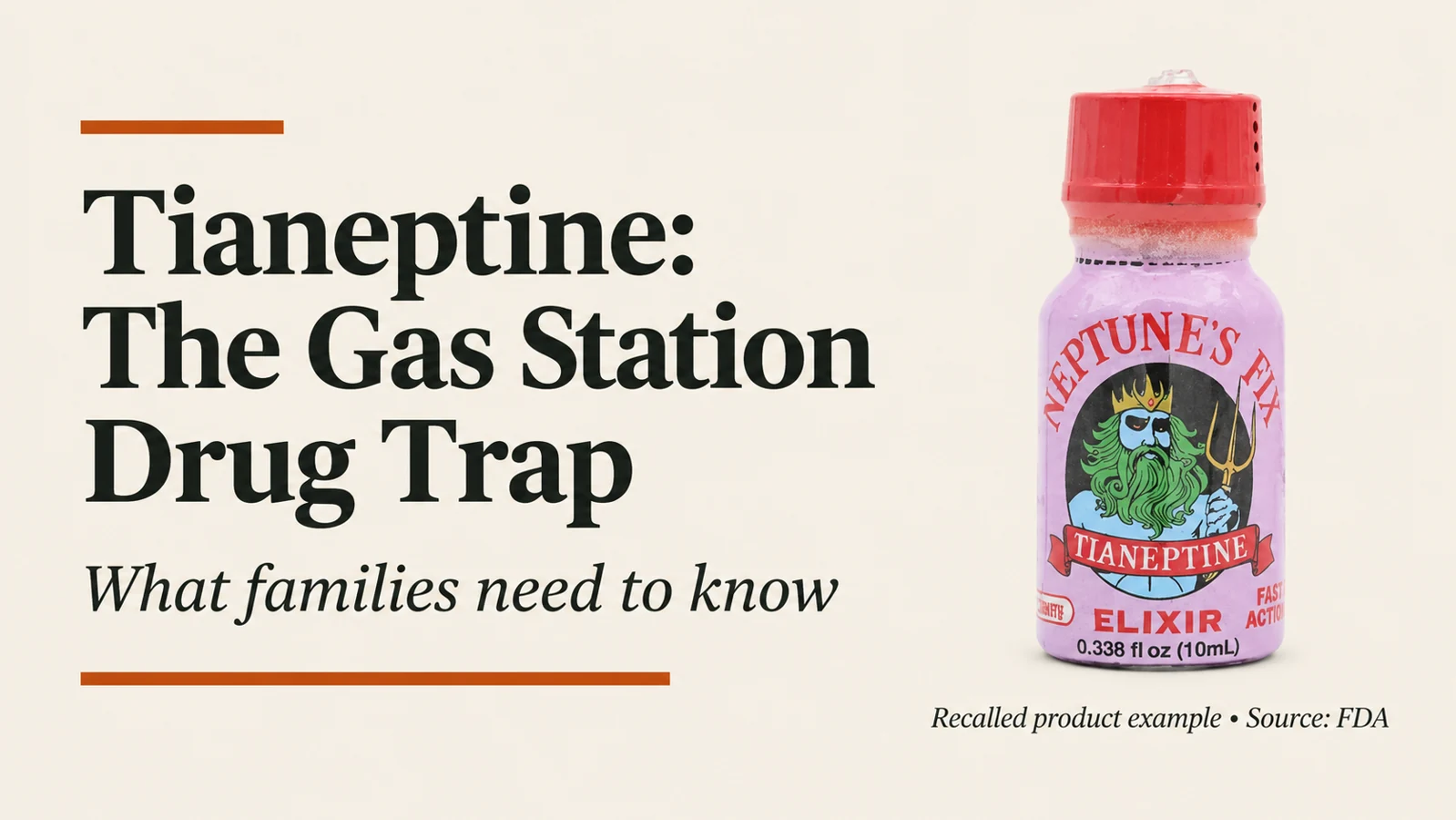
Someone you love may be buying a small bottle or packet from a convenience store and insisting that it cannot be a serious drug. Meanwhile, the purchases are becoming more frequent. They feel sick without it, disappear for another store trip, or spend money they cannot afford. If the product contains tianeptine, the family may be confronting opioid-related dependence without ever having heard the drug’s name.
Tianeptine is sometimes called “gas station heroin.” That nickname communicates alarm, but it is not a chemical identification: tianeptine is not heroin. A useful response requires more than a frightening label. Families need to understand the actual substance, recognize a medical emergency, and help someone reach care without turning the conversation into a contest over who is right.
This guide addresses parents, partners, adult children, and friends. It explains the evidence, the limits of the available statistics, and practical decisions when someone cannot stop. Product and regulatory information was checked November 6, 2026.
Key Points
- Tianeptine is not FDA-approved for any medical use in the United States. Retail availability is not medical approval.
- It has opioid activity and can be associated with dependence, withdrawal, poisoning, and serious harm.
- FDA warnings name products including Tianaa, Zaza, Neptune’s Fix, Pegasus, and TD Red. Brand names do not guarantee a consistent formula.
- A national poison-center study found substantial medical severity among reported exposures; those reports do not measure the risk for every user.
- Some tested products in a New Jersey illness cluster contained additional drugs, illustrating why the package alone may not explain the presentation.
- Withdrawal and ongoing use both deserve professional assessment. Replacing tianeptine with another smoke-shop product is not a treatment plan.
- If someone is unresponsive or breathing abnormally, call 911 and use available naloxone as directed for suspected opioid overdose.
Tianeptine at a Glance
| Question | Useful answer for families |
|---|---|
| What is tianeptine? | A drug with opioid-receptor activity, sold in some countries as a prescription antidepressant but not approved as a medicine in the United States. |
| How might it be presented? | Capsules, tablets, or liquids with mood, focus, or wellness-style messaging; actual products and labels vary. |
| What should raise concern? | Repeated purchasing, inability to cut back, using to avoid sickness, impaired functioning, or continued use despite consequences. |
| Can a retail label establish safety? | No. A familiar store, supplement-style package, or customer testimonial does not establish clinical safety. |
| What information helps clinicians? | The exact product and lot, photographs, approximate timing and pattern of use, symptoms, medications, alcohol, and other substances. |
| What is urgent? | Unresponsiveness, abnormal breathing, seizures, severe confusion, or other signs of a medical emergency. |
| What comes after stabilization? | Assessment of dependence, mental and physical health needs, treatment options, and practical support for follow-through. |
What Tianeptine Is and Why the Store Counter Is Misleading
The FDA warns consumers against tianeptine products and states that the substance is not approved for medical use in the United States. It also does not qualify as a lawful dietary ingredient or an approved food additive. A package that resembles a supplement does not change that status. The FDA has linked these products to serious adverse events, including overdose and death. (U.S. Food and Drug Administration [FDA], 2025a)
People do not all begin using for the same reason. One person may be seeking an intoxicating effect; another may believe they have found something for emotional distress, pain, or energy. Some are trying to replace another drug or avoid withdrawal. That starting point matters when planning help because the original problem may still need attention after use stops.
The familiar purchase setting can make the problem difficult to acknowledge. A person may compare the bottle to an energy drink rather than to an opioid-active drug. Families can avoid getting trapped in that comparison by returning to observable consequences: missed obligations, increasing expense, sickness between purchases, or changes in alertness. Those facts remain relevant regardless of the aisle where the product was sold.
Do not assume someone has knowingly concealed every risk. They may have believed the marketing, misunderstood an ingredient, or gradually lost control after an initially occasional habit. Taking their explanation seriously does not require accepting continued danger. It helps identify what an effective treatment conversation needs to address.
What the Poison-Center Data Show
A study of U.S. poison-center reports identified 892 single-substance tianeptine exposures from 2015 through 2023. Approximately 51.5% had moderate medical outcomes and 12.0% had major outcomes. Medical admission occurred in 40.1%, including critical-care admission in 22.9%. Withdrawal was recorded in 22.5%. These figures describe reported cases, a group selected by circumstances that prompted a call; they are not the expected outcome of every exposure. (Quadir et al., 2025)
| Study measure | Finding | What it means and does not mean |
|---|---|---|
| Single-substance exposures, 2015–2023 | 892 reports | A national surveillance sample, not every person who used tianeptine. |
| Moderate or major outcomes | 51.5% moderate; 12.0% major | Serious clinical problems occurred among reported cases. |
| Medical admission | 40.1%; 22.9% critical care | Many reported cases needed substantial medical services. |
| Withdrawal | 22.5% | Calls concerned withdrawal as well as intoxication. |
| Age distribution | Ages 30–39 accounted for 36.6%; 20–29 for 22.3%; 40–49 for 20.0%. | The issue was prominent among adults, not exclusively teenagers. |
The table is drawn from Quadir and colleagues’ study. A poison-center record can contain uncertainty about exactly what was consumed, and reporting is incomplete. It cannot establish how many people nationwide have tianeptine dependence. Nor should a family use the absence of a person’s age group from a headline to conclude that their situation is low risk.
Data are most useful when they correct a mistaken assumption: this is not simply an internet rumor or a concern limited to one age. They are less useful when turned into a prediction about one person sitting at the kitchen table. That person needs assessment based on their symptoms, health, and actual pattern of use.
Tianaa, Zaza, Neptune’s Fix, and Changing Formulas
FDA communications identify several product names associated with tianeptine. Names can help a family recognize a package, but an article cannot certify every current or past version of a brand. Different flavors, colors, lots, or reformulations may have different ingredients. Keep the actual container and take clear photographs of the front, back, and lot information instead of relying only on a remembered name.
Neptune’s Fix provides a concrete example of why this matters. A CDC report described 20 exposure calls involving 17 people in New Jersey between June and November 2023. Testing of products connected with the investigation identified synthetic cannabinoids in addition to tianeptine. This was a specific cluster, not proof that every tianeptine product contains those drugs. (Counts et al., 2024)
Neptune Resources subsequently announced a nationwide recall of Neptune’s Fix elixirs and tablets. The recalled bottle shown in this article is a historical identification example, not an endorsement or a depiction of every product on sale today. (Neptune Resources, LLC, 2024)
The practical lesson is to give medical professionals the best available information without pretending that you have confirmed the contents. “This is the package we found” is more accurate than “We know exactly what was taken.” If the person used several products, disclose all of them. A new symptom should not be dismissed because it does not match a short internet list.
Tianeptine, 7-OH, and Benzodiazepines: Important Differences
| Substance or category | Key distinction | Why a family should care |
|---|---|---|
| Tianeptine | A distinct opioid-active drug; not a kratom alkaloid. | Calling it “kratom” may obscure the actual exposure. |
| Concentrated 7-OH | A kratom-related opioid-active compound. | Switching to it does not establish that dependence has resolved. |
| Prescribed benzodiazepine | A different drug class with potentially serious withdrawal risks. | Medication changes require the prescriber’s guidance. |
| Unknown retail blend | A marketing label may not define every active ingredient. | The clinician needs the precise product and an honest account of uncertainty. |
A person may describe changing products as getting clean because they have stopped buying one particular bottle. Ask about the whole pattern. Are they still becoming impaired? Are they taking a replacement to avoid feeling sick? Is spending continuing? A change in packaging can coexist with the same underlying dependence.
Combining opioid-active substances with alcohol or benzodiazepines raises particular concerns about sedation and breathing. The FDA’s warning about opioids and benzodiazepines explains why complete disclosure matters. Do not independently discontinue a prescribed benzodiazepine: abrupt withdrawal can also be dangerous. (FDA, 2016) (FDA, 2020)
Our 7-OH family guide explains that separate marketplace. Neither article offers a conversion chart between products. Such a chart would imply a reliability and medical appropriateness that retail formulations and individual circumstances do not support.
Recognizing Dependence Without Playing Detective
Look for patterns rather than treating one behavior as proof. A person may start arranging errands around access, become preoccupied with keeping a supply, or borrow repeatedly without a clear explanation. They may cancel plans that would interrupt their routine. These observations can justify a conversation, but none independently establishes a diagnosis.
Ask what happens when they try not to use. Someone who says, “I can stop whenever I want,” may also admit that stopping means being unable to sleep or function. That contradiction is worth exploring gently. The goal is to understand the problem well enough to obtain care, not to win an argument by catching the person in a lie.
Separate observations from interpretations in your notes. “Left work twice this week to purchase more” is more useful than “Has no self-control.” “Reported feeling sick after running out” is more helpful than “Was manipulating us.” An assessment can then consider dependence alongside pain, mental health, other medications, and environmental pressures.
Families also need boundaries around their own role. You can offer a ride, help organize information, or pay a provider directly if that fits your circumstances. You do not have to provide unrestricted cash or cover every consequence. Agree on boundaries privately before presenting them, so the person receives a clear message instead of several conflicting offers.
When to Seek Emergency Help
Call 911 if someone cannot be awakened, is breathing slowly or abnormally, has a seizure, or appears critically ill. For suspected opioid overdose, give available naloxone according to its instructions and follow the dispatcher’s directions. Remain with the person. Emergency evaluation is still necessary if they improve. (Substance Abuse and Mental Health Services Administration [SAMHSA], 2025)
Do not wait for a routine drug test to confirm your suspicion. Tell responders about tianeptine, the product name, other substances, and any uncertainty. Do not give another drug to counteract the first or try to make the person vomit. If safe, have the packaging available without delaying the emergency call.
For a possible exposure without an immediate life-threatening emergency, U.S. Poison Control is available at 1-800-222-1222. If a child may have swallowed a product, seek advice promptly rather than waiting for obvious symptoms. Keep remaining products secured away from children and pets while following professional advice about handling or disposal.
What to Do When Someone Cannot Stop Taking Tianeptine
Start with a medical assessment rather than a home-designed withdrawal schedule. Explain whether the person is currently using, trying to stop, or experiencing symptoms after running out. Ask the service whether it can assess this exposure and arrange addiction-medicine input. A general promise to “handle addiction” is less useful than a clear explanation of who evaluates withdrawal and what happens if urgent care is needed.
For people diagnosed with opioid use disorder, evidence-based care may include medications alongside other supports. The appropriate choice depends on an individual assessment; this article does not prescribe a medication or an induction schedule for tianeptine. Families can ask whether a provider offers or coordinates appropriate medication treatment rather than assuming that support groups alone address every medical need. (SAMHSA, 2021)
Plan the practical details before an appointment is offered. Who will provide transportation? Can the person miss work? Who will care for children? What records are needed? If a first program is unsuitable, who will help locate an alternative? Removing those barriers is often more helpful than repeating that the person needs to take the situation seriously.
Assessment should also address why use began. If untreated pain, anxiety, or depression is part of the story, leaving that need unanswered can make the next step feel impossible. Ask how those concerns will be evaluated and how existing clinicians will coordinate care. Do not assume every symptom is caused by the retail product.
Supporting a Teen, Partner, or Parent Through the Next Step
When the person is a teenager
Involve a qualified adolescent professional and appropriate caregivers. Avoid turning the discovery into a public accusation, a social-media warning about the child, or a task assigned to siblings. Ask what the young person thought the product was and whether peers are sharing other substances. Safety and an accurate history matter more than forcing an immediate confession about every detail.
When the person is an adult
Respect that an adult makes their own treatment decisions while being clear about your boundaries. Offer a specific assessment and practical help. If they decline, decide what you will do next rather than promising consequences you cannot maintain. If an adult is responsible for children, driving, or another safety-sensitive duty, address immediate impairment directly and arrange safe alternatives.
When the family is divided
One relative may focus on compassion while another wants consequences. Both may be reacting to the same fear. Before a planned conversation, agree on the observable concerns, the offer of help, and the boundaries each person controls. Avoid rehearsing insults or asking the person to respond to a long list of historical grievances. Keep the request understandable: obtain an assessment and discuss the recommended next step.
The Firm’s gas-station drug intervention services can help families organize this process. Family coaching can support communication and boundaries, while treatment placement guidance can help families compare appropriate options. The Firm is not an emergency service or a medical detox provider. Medical stabilization takes priority when symptoms are urgent.
Questions to Ask Before Choosing a Program
A family searching for help may encounter confident promises before anyone has reviewed the person’s history. Slow the decision down enough to establish what the program actually provides. Ask who evaluates medical stability, who manages withdrawal, and how the program coordinates with emergency services when the person’s condition exceeds its capabilities. A clear explanation of limits is a strength, not a reason to reject a provider.
Ask whether the team has experience assessing tianeptine or can obtain specialist input. Experience with a familiar opioid does not automatically answer every question about an uncertain retail mixture. At the same time, unfamiliarity with a brand should not prevent the service from recognizing an emergency or arranging appropriate consultation.
Clarify the transition after initial stabilization. Who schedules follow-up? How are ongoing mental-health or pain concerns addressed? What happens if the person cannot attend the recommended appointment? Families should not discover at discharge that the next step depends on a waiting list they did not know about.
Ask about communication and consent. An adult may want help with transportation while keeping clinical details private. Agree on what information can be shared and how urgent safety concerns will be handled. For adolescents, ask the provider to explain applicable confidentiality and caregiver-involvement rules rather than assuming that they are identical across services.
Cost questions are part of responsible planning. Request a clear description of charges, insurance arrangements, services included, and outside care that may be billed separately. Avoid choosing solely because a website promises immediate transformation. The relevant question is whether the service can meet the person’s assessed needs and support a workable next step.
Finally, ask the person what has made previous help difficult. A missed appointment may reflect fear, transportation, shame, or a poor prior experience. Understanding that barrier does not excuse ongoing harm; it helps the family make its offer more usable. A concrete ride to an appropriate appointment can accomplish more than another general demand to get help.
Write the answers in one place and compare options using the same questions. This prevents a persuasive sales conversation from replacing a careful decision. If the person is medically unstable, however, do not postpone urgent care while completing a program comparison.
Frequently Asked Questions
Is tianeptine the same as heroin?
No. “Gas station heroin” is a nickname, not a chemical description. Tianeptine is a distinct drug with opioid activity and serious potential risks. Use the actual drug and product names when speaking with medical professionals.
Can a supplement-style label mean the product is approved?
No. The FDA has not approved tianeptine for medical use in the United States. Packaging, retail availability, and online reviews do not establish approval or safety.
Does every Zaza or Neptune’s Fix package have the same contents?
Do not assume that. Versions and lots can differ, and historical information may not describe a current package. Preserve the actual label and lot information for assessment.
Should I make my loved one stop immediately at home?
Seek medical advice about current use and withdrawal rather than creating a home plan. If the person is critically ill, call 911. Include all medications and substances in the assessment.
Will a routine drug screen answer the question?
Not necessarily. Testing depends on the substances included in the specific panel. Tell the clinician that tianeptine is suspected and share the packaging; a negative routine result should not overrule concerning symptoms.
Is switching to 7-OH a safer way to stop?
It is not an established treatment plan. Concentrated 7-OH has its own opioid-related risks. A clinician should assess dependence and appropriate care instead of relying on retail substitutions.
Can an intervention happen before the person agrees there is a problem?
A planned family conversation can offer assessment without requiring agreement on a diagnosis first. It should be based on observed harm, realistic support, and appropriate professional guidance, not confrontation during intoxication or medical instability.
What can I do today?
Document the product and recent pattern, check immediate safety, and arrange an appropriate assessment. For help organizing a family response, contact The Firm or call 877-FIRM-910. Use emergency services for urgent medical symptoms.
References
Counts, C. J., Spadaro, A. V., Cerbini, T. A., Krotulski, A. J., Greller, H. A., Nelson, L. S., Ruck, B. E., & Calello, D. P. (2024). Notes from the field: Cluster of severe illness from Neptune’s Fix tianeptine linked to synthetic cannabinoids: New Jersey, June–November 2023. Morbidity and Mortality Weekly Report, 73(4), 89–90. https://doi.org/10.15585/mmwr.mm7304a5
Ingham, J. (2026, October 2). What is tianeptine? The dangers behind “gas station heroin”. Brooks Healing Center. https://brookshealingcenter.com/blog/tianeptine/
Neptune Resources, LLC. (2024, January 28). Neptune Resources, LLC issues voluntary nationwide recall of Neptune’s Fix. U.S. Food and Drug Administration. Recall notice.
Quadir, M., Rine, N. I., Badeti, J., Hays, H. L., Michaels, N. L., Yang, J., & Smith, G. A. (2025). Tianeptine exposures reported to United States poison centers, 2015–2023. Journal of Medical Toxicology, 21(1), 30–41. https://doi.org/10.1007/s13181-024-01053-6
Substance Abuse and Mental Health Services Administration. (2021). Medications for opioid use disorder (Treatment Improvement Protocol 63). Treatment guidance.
Substance Abuse and Mental Health Services Administration. (2025). Overdose prevention and response. Overdose resources.
U.S. Food and Drug Administration. (2016, August 31). New safety measures announced for opioid analgesics, prescription opioid cough products, and benzodiazepines. Safety announcement.
U.S. Food and Drug Administration. (2020, September 23). FDA requiring boxed warning updated to improve safe use of benzodiazepine drug class. Drug safety communication.
U.S. Food and Drug Administration. (2025a, May 8). FDA warns consumers not to purchase or use any tianeptine product due to serious risks. Consumer warning.
U.S. Food and Drug Administration. (2025b, May 8). New “gas station heroin” tianeptine product trend. Clinical safety information.
Educational information, not a diagnosis or individualized treatment plan. Product examples are included for identification and reporting context, not endorsement.