
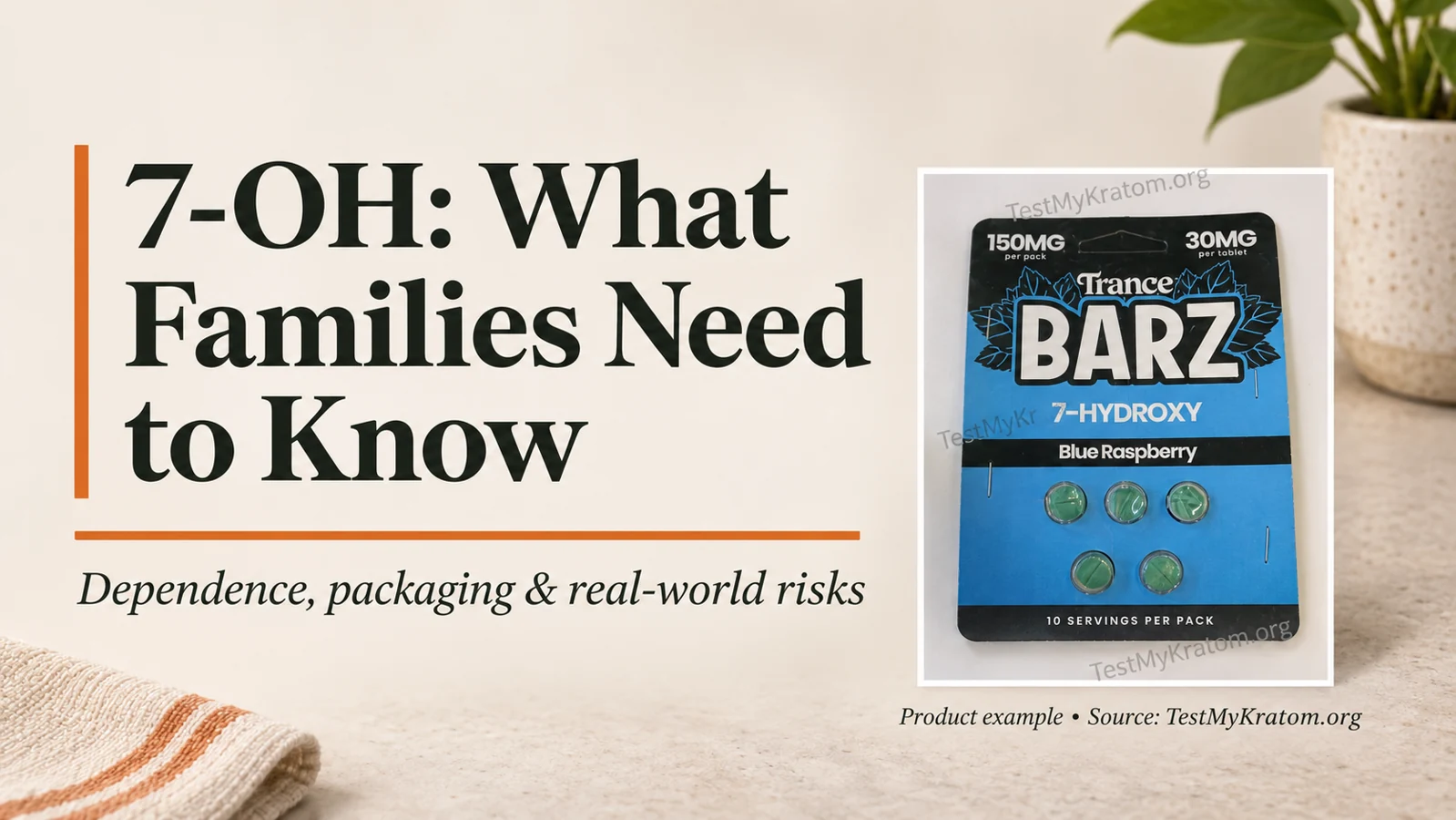
A brightly colored packet on a gas-station counter can look less consequential than a prescription bottle. That impression can be dangerously misleading. Concentrated 7-hydroxymitragynine, usually called 7-OH, is sold in a marketplace that borrows the language of botanicals, convenience, relaxation, and powerful effects. A person can buy a product without understanding that they are entering an opioid-related cycle of tolerance, withdrawal, and repeated use.
For a parent, partner, or friend, the first clue may not be the packet. It may be a person who cannot get through the morning without another tablet, makes increasingly frequent store trips, or becomes panicked when a preferred brand disappears. Those patterns deserve attention even when the person insists, “It came from a store.” A retail transaction does not provide a medical assessment or establish a product’s safety.
This guide explains what 7-OH is, what current data can tell us, how to discuss BARZ and other branding accurately, and what families can do when use is becoming difficult to control. Regulatory information was checked on November 6, 2026; product formulas and legal rules can change.
Key Points
- Concentrated 7-OH products are different from traditional kratom leaf preparations. Treating every product as interchangeable obscures important risks.
- Dependence can become apparent when a person uses to avoid feeling sick rather than to obtain a desired effect.
- BARZ and BARS are different names. A package, flavor, tablet shape, or old photograph cannot establish the ingredients in another product.
- Bar-shaped packaging can evoke familiar prescription-drug imagery, but appearance does not prove a manufacturer’s intent to target teenagers.
- Alcohol, benzodiazepines, and other sedating substances create additional concerns when combined with opioid-active products.
- Poison-center reports are warning signals, not a measurement of how many Americans use a product or the probability that one user will overdose.
- Medical evaluation comes before an improvised home detox or a family confrontation with someone who is impaired.
7-OH at a Glance
| Question | What families should understand |
|---|---|
| What is it? | 7-hydroxymitragynine, an opioid-active kratom-related alkaloid; concentrated commercial formulations are the focus of this article. |
| Where might it appear? | Tablets, chewables, shots, and other products marketed online or through convenience and smoke-shop channels. Availability varies. |
| Why does formulation matter? | The amount and combination of active compounds can differ substantially between leaf material, extracts, and manufactured tablets. |
| What suggests a developing problem? | Repeated unsuccessful attempts to cut back, using despite harm, escalating spending, and organizing daily life around avoiding withdrawal. |
| What needs immediate help? | Unresponsiveness, slow or abnormal breathing, a seizure, or another medical emergency. |
| What should accompany an assessment? | Photographs of the exact package, ingredient panel, lot number, recent use pattern, other substances, and prescribed medications. |
| What is the family’s role? | Recognize patterns, arrange appropriate help, protect safety, and establish workable boundaries, not calculate a replacement-drug regimen. |
What Is 7-OH, and How Is It Different From Kratom?
Kratom is a plant with multiple alkaloids. Mitragynine is its principal psychoactive alkaloid; 7-OH is a related compound with stronger activity at the mu-opioid receptor. Traditional leaf products and highly concentrated 7-OH formulations should not be described as though they deliver the same exposure. The FDA’s public-health messaging specifically distinguishes concentrated 7-OH products from natural leaf products. Neither that distinction nor a botanical origin establishes that a particular retail product is safe. (U.S. Food and Drug Administration [FDA], n.d.)
A useful family question is not simply, “Is this kratom?” It is, “What exact product is this, and what does its label actually identify?” A powder, a shot, and a scored tablet can have very different compositions. A familiar brand name can also remain on a package after a formulation changes. Save the information attached to the actual product rather than relying on a general internet description.
People use these products for different reasons. Some seek intoxication; others are trying to manage pain, anxiety, exhausting work schedules, or withdrawal from another substance. Understanding that reason matters because the replacement plan must address the underlying need. Telling someone to stop without helping them access care for pain or dependence can leave the same pressures intact.
That does not mean the family must accept ongoing harm. It means the conversation should connect the behavior to a realistic next step: an addiction-medicine appointment, a review of existing prescriptions, or an assessment of the appropriate level of care. A product debate alone rarely answers those questions.
What the Data Show and What They Do Not
America’s Poison Centers reported 593 exposures involving 7-OH in 2025 and 901 during January–June 2026. That is a meaningful surveillance signal, especially because the latter figure covers only half a year. These are reported exposures, however, not confirmed nationwide prevalence or a count of unique people with addiction. Reporting practices and substance coding also affect comparisons. (America’s Poison Centers, 2026)
| Evidence | Finding | Limit on interpretation |
|---|---|---|
| 7-OH poison-center surveillance | 593 reported exposures in 2025; 901 in the first six months of 2026. | Different observation periods; not the percentage of users harmed. |
| Broader kratom-related surveillance, 2015–2025 | Reports rose from 258 to 3,434 annually. | The broader category cannot be treated as a 7-OH-only dataset. |
| Age patterns in that broader study | Most reports involved ages 20–39; reports among ages 40–59 rose sharply. | These patterns do not establish a teen-specific BARZ trend. |
| Brand-specific teen outcomes | No reliable population estimate was identified for this article. | Absence of a count does not establish safety or prove targeted marketing. |
The broader figures come from a 2026 CDC-published analysis of National Poison Data System reports. Its authors also found worse outcomes in reports involving multiple substances. Those findings support asking about alcohol, pills, and other products together, rather than treating each package as a separate issue. They do not establish that a named brand caused a particular reported outcome. (Towers et al., 2026)
Families do not need a perfect national statistic before acting on local evidence. Missed work, impaired driving, repeated borrowing, or sickness when supply runs out are concrete reasons to seek assessment. At the same time, an honest article should not fill gaps with dramatic claims about how many teenagers are using a brand. Precision makes the warning more credible.
BARZ, BARS, and the Familiarity of Pill Marketing
Identify the product before interpreting the name
A publicly posted Anresco Laboratories report identifies a sample as Trance Barz Blue Raspberry, lot 2025-07. Its photograph shows round tablets, not a rectangular Xanax-style bar. The report lists 18.33 mg of 7-OH and 1.38 mg of mitragynine pseudoindoxyl per tested tablet. Those findings apply to that submitted sample, not every BARZ product or every package carrying a similar name. The report states that the laboratory did not perform the sampling. (Anresco Laboratories, 2025)
Separately, Get Bars markets BARS products, including rectangular scored tablets and a newer alternative line. These should not be conflated with Trance BARZ. In the material reviewed, the BARS collection promotes effects including euphoria and relaxation, while also stating an under-21 restriction. A seller’s claims describe its marketing; they are not independent clinical evidence. (Get Bars, n.d.)
Why the resemblance deserves discussion
A rectangular, scored tablet and “bars” terminology can call to mind the familiar appearance and slang associated with some alprazolam products. That is a reasonable visual comparison. It is not proof that the substance is alprazolam, that the effects are interchangeable, or that a company deliberately designed a campaign for minors. We did not find evidence establishing those intentions.
The concern for families is still real. Familiar visual cues may make an unfamiliar product feel easier to understand than it is. A teenager who already recognizes benzodiazepine imagery may assume a similarly shaped tablet belongs to the same category. Parents should ask what the young person believes the product contains, not assume they accurately understand it.
It is also inaccurate to say that teens generally start with benzodiazepines and progress to 7-OH. Individual histories differ, and the sources reviewed do not establish that sequence. If your own child has used benzodiazepines, that history is clinically important. It should prompt a specific discussion about combined use, access, withdrawal risk, and assessment, not a claim about every teenager.
7-OH, Xanax, and Other Products Are Not Interchangeable
| Product or substance | Important distinction | Family implication |
|---|---|---|
| Concentrated 7-OH | Opioid-active kratom-related product. | Discuss dependence and respiratory-depression concerns with a clinician. |
| Prescribed alprazolam | A benzodiazepine with its own indications, interactions, and withdrawal risks. | Do not stop or change an established prescription without the prescriber’s guidance. |
| Unverified “Xanax” tablet | Appearance does not establish contents. | Treat identification as uncertain and share that uncertainty with medical professionals. |
| A “7-OH alternative” | A marketing category, not one defined chemical. | Read the exact formulation; do not assume equivalent effects or lower risk. |
The FDA warns that combining opioid medicines with benzodiazepines or other central-nervous-system depressants, including alcohol, can cause dangerous sedation and slowed breathing. For a person using an opioid-active retail product, disclosure of benzodiazepines and alcohol is therefore essential. Do not interpret a person’s ability to remain awake after previous combinations as proof that the next exposure will be safe. (FDA, 2016)
A family should not abruptly confiscate a regularly used benzodiazepine and assume that solving one access problem solves the medical problem. Benzodiazepine withdrawal can be serious, including seizures. A clinician needs the complete picture to plan safely. (FDA, 2020)
When Use Becomes Dependence
The pattern can become visible in ordinary routines: leaving a family gathering to buy more, declining a trip because access is uncertain, or waking early to avoid feeling unwell. These examples are illustrative, not diagnostic. They are useful because they connect the concern to observable behavior rather than an argument about whether the person looks like someone with addiction.
Physical dependence and a substance use disorder are related but not identical concepts. Dependence involves adaptation and withdrawal; a disorder involves a broader pattern of impaired control and harm. A qualified clinician makes that assessment. Families can describe what they see without trying to deliver a diagnosis at the dinner table.
Ask about attempts to stop. “What happened the last time you went without it?” may reveal more than “How many do you take?” The person may describe poor sleep, feeling sick, distress, or returning to use to function. Do not respond by designing a taper from online anecdotes. The appropriate plan depends on the actual products, other substances, health conditions, and current symptoms.
Be especially attentive when the person changes brands or substitutes a new compound because a familiar one is unavailable. Relief from withdrawal may reinforce continued use even when the person sincerely wants to stop. Our guides to mitragynine pseudoindoxyl and MGM-15 and MGM-16 explain why changing names does not automatically resolve dependence.
What to Do if Someone Seems Overdosed or Unwell
If someone cannot be awakened, has slow or abnormal breathing, or is having a seizure, call 911. If an opioid overdose is suspected and naloxone is available, administer it according to its instructions and follow the dispatcher’s guidance. Stay with the person; improvement after naloxone does not remove the need for emergency care. (Substance Abuse and Mental Health Services Administration [SAMHSA], 2025)
Do not delay emergency action while trying to identify the exact brand, check a laboratory report, or decide whether the substance is technically an opioid. Tell responders what you know and what you do not know. If safe, make the package available. Avoid making someone vomit or giving them another substance to “balance out” the effects.
For a possible exposure without immediate life-threatening symptoms, U.S. Poison Control can be reached at 1-800-222-1222. An exposure involving a child warrants prompt advice even if the child initially appears well. Keep products away from children and pets, and do not leave loose tablets where they can be mistaken for ordinary medication or candy.
How to Talk With a Teen or Adult Child About 7-OH
Begin with an observation and a concern: “I found this packet, and I have noticed you are getting sick when you cannot get more. I want us to get medical advice.” That leaves room for the person to explain what is happening without requiring you to pretend the situation is harmless. A calm tone and clear limits can coexist.
Ask what they were hoping the product would do. Sleep, pain relief, relief from anxiety, fitting in, and avoiding withdrawal lead to different treatment questions. Do not promise confidentiality you cannot keep if immediate safety is at stake. For a minor, involve appropriate caregivers and qualified adolescent professionals while respecting applicable consent and confidentiality rules.
Choose a time when the person can participate. A confrontation while someone is heavily sedated, in severe withdrawal, or threatening violence is not a productive intervention. Move toward urgent professional help when the situation calls for it. Do not use younger siblings as messengers or ask them to monitor another person’s breathing or substance use.
For an adult child, focus on what you can control. You can offer transportation to assessment, help arrange an appointment, or stop providing unrestricted spending money. You cannot guarantee that a particular consequence will make them choose treatment. Avoid threats that the family cannot safely or consistently follow through on.
Assessment, Treatment, and a Family Intervention Plan
Bring a concise timeline to the first assessment: when use began, known products, changes in frequency, attempts to stop, episodes of impairment, and other substances. Include medications prescribed by legitimate clinicians. A person should not have to remember every detail while distressed; photographs and a written summary can make the visit more useful.
Ask the clinician how they evaluate dependence involving 7-OH and whether addiction-medicine expertise is needed. Treatment decisions may include withdrawal management, ongoing medication, therapy, and support for the original reason the person started using. FDA-approved medications for opioid use disorder include buprenorphine, methadone, and naltrexone; whether and how they fit an individual case requires medical evaluation. (SAMHSA, 2021)
If the person refuses help, a professional gas-station drug intervention consultation can help the family organize its response. The work should include appropriate safety screening, a treatment option that can actually accept the person, a plan for transportation, and an agreement about what happens if the person declines.
An intervention is not a substitute for detoxification or emergency medicine. The Firm can help with kratom and 7-OH intervention planning, treatment navigation, and family consulting. The aim is a coordinated, informed next step rather than a dramatic confrontation or a promise of a guaranteed outcome.
After an initial treatment decision, the family still needs a practical plan. Who will help coordinate appointments? What happens if another packet appears? How will prescribed treatment be supported rather than undermined? A written agreement can reduce repeated arguments and keep the focus on observable responsibilities. It should be reviewed as circumstances change rather than used as a permanent punishment.
Following Through After the First Appointment
The first appointment is a beginning, not proof that the situation is resolved. Ask the person what follow-up was recommended and what practical help they want. With appropriate permission, family members can clarify their role with the care team. Respect privacy rather than assuming that paying for an appointment entitles everyone to every clinical detail.
Make the next few days concrete. Identify transportation, scheduled visits, work or school arrangements, and who to call if symptoms worsen. A plan that depends on one exhausted relative being available at all hours is fragile. Share practical responsibilities where possible while leaving medical decisions to qualified professionals.
Discuss access and spending as part of a broader household agreement. The aim is not to build a surveillance system around the person. It is to make expectations understandable: no impaired driving, no products left accessible to children, and clear limits on financial assistance. Each boundary should describe an action the family can actually maintain.
If use resumes, respond to the current level of risk and contact the treating team rather than treating the event only as a broken promise. Ask what interrupted the plan: symptoms, access to care, pain, social pressure, or another obstacle. Do not assume you know the explanation. An honest account gives professionals more information for revising care.
Family members also need a sustainable source of support. Coaching, counseling, or an appropriate peer-support setting can help relatives communicate consistently and avoid making every conversation about the product. Recovery support should leave room for ordinary family life while remaining clear about safety.
Frequently Asked Questions
Is 7-OH the same as heroin?
No. They are different substances. The comparison sometimes used in headlines points to opioid-related concerns, not chemical identity. Accurate identification and assessment are more useful than treating every opioid-active product as the same drug.
Does a BARZ package mean the tablets contain Xanax?
No. The name does not establish alprazolam content. The Trance BARZ sample discussed here was labeled as a 7-hydroxy product and pictured round tablets. Other similarly named products require their own identification.
Are these products deliberately marketed to teenagers?
The reviewed evidence supports discussing flavors, imagery, names, and effect claims. It does not establish a named company’s intent to target teens. BARS also displays an age restriction. Families can address potential youth appeal without claiming an unproven intent.
Can a normal drug screen rule out 7-OH use?
Do not assume it can. Ask the laboratory or clinician exactly which substances the test measures and how results should be interpreted. A negative routine screen does not explain every episode of impairment.
Should we switch to a different gas-station product to stop?
Do not use a retail replacement as a self-directed treatment plan. Another product may contain different active substances or maintain dependence. Bring the current product information to an addiction-qualified clinician.
Does a passing laboratory report mean a product is safe?
No. A report describes the submitted sample and the tests performed. It does not establish clinical safety, suitability for a particular person, or the contents of every future lot.
Can parents get help before their adult child agrees?
Yes. Parents can seek consultation about communication, boundaries, treatment options, and safety. The person’s participation and consent remain important, and emergency situations require emergency services.
What is the next step if we are worried?
Arrange a medical assessment for current use or withdrawal concerns. For family planning and treatment refusal, contact The Firm or call 877-FIRM-910. An initial service inquiry is at no charge.
References
America’s Poison Centers. (2026, July 8). Health advisory: Serious illnesses associated with kratom and 7-OH products. https://poisoncenters.org/news-alerts/13651143
Anresco Laboratories. (2025, July 30). Certificate of analysis: Trance Barz 30mg Blue Raspberry tablet, sample 1323159, lot 2025-07 [Laboratory report]. TestMyKratom.org. Product-specific laboratory report.
Get Bars. (n.d.). 7-OH tablets & 7-hydroxymitragynine products [Manufacturer marketing page]. Retrieved November 6, 2026, from https://getbars.co/collections/7oh-tablets
Substance Abuse and Mental Health Services Administration. (2021). Medications for opioid use disorder (Treatment Improvement Protocol 63). https://www.samhsa.gov/resource/recovery/medications-opioid-use-disorder
Substance Abuse and Mental Health Services Administration. (2025). Opioid overdose prevention and reversal. https://www.samhsa.gov/substance-use/treatment/overdose-prevention
Towers, E. B., Thomas, Y. T., Holstege, C. P., & Farah, R. (2026). Increases in kratom-related reports to poison centers: National Poison Data System, United States, 2015–2025. Morbidity and Mortality Weekly Report, 75(11), 139–145. https://www.cdc.gov/mmwr/volumes/75/wr/mm7511a1.htm
U.S. Food and Drug Administration. (2016, August 31). New safety measures announced for opioid analgesics, prescription opioid cough products, and benzodiazepines. FDA safety announcement.
U.S. Food and Drug Administration. (2020, September 23). FDA requiring boxed warning updated to improve safe use of benzodiazepine drug class. FDA benzodiazepine safety communication.
U.S. Food and Drug Administration. (n.d.). Hiding in plain sight: 7-OH products. Retrieved November 6, 2026, from https://www.fda.gov/news-events/public-health-focus/hiding-plain-sight-7-oh-products
Educational information, not individualized medical advice. Product examples are included for identification and critical discussion, not endorsement. The featured graphic incorporates the product photograph from the cited laboratory report.