
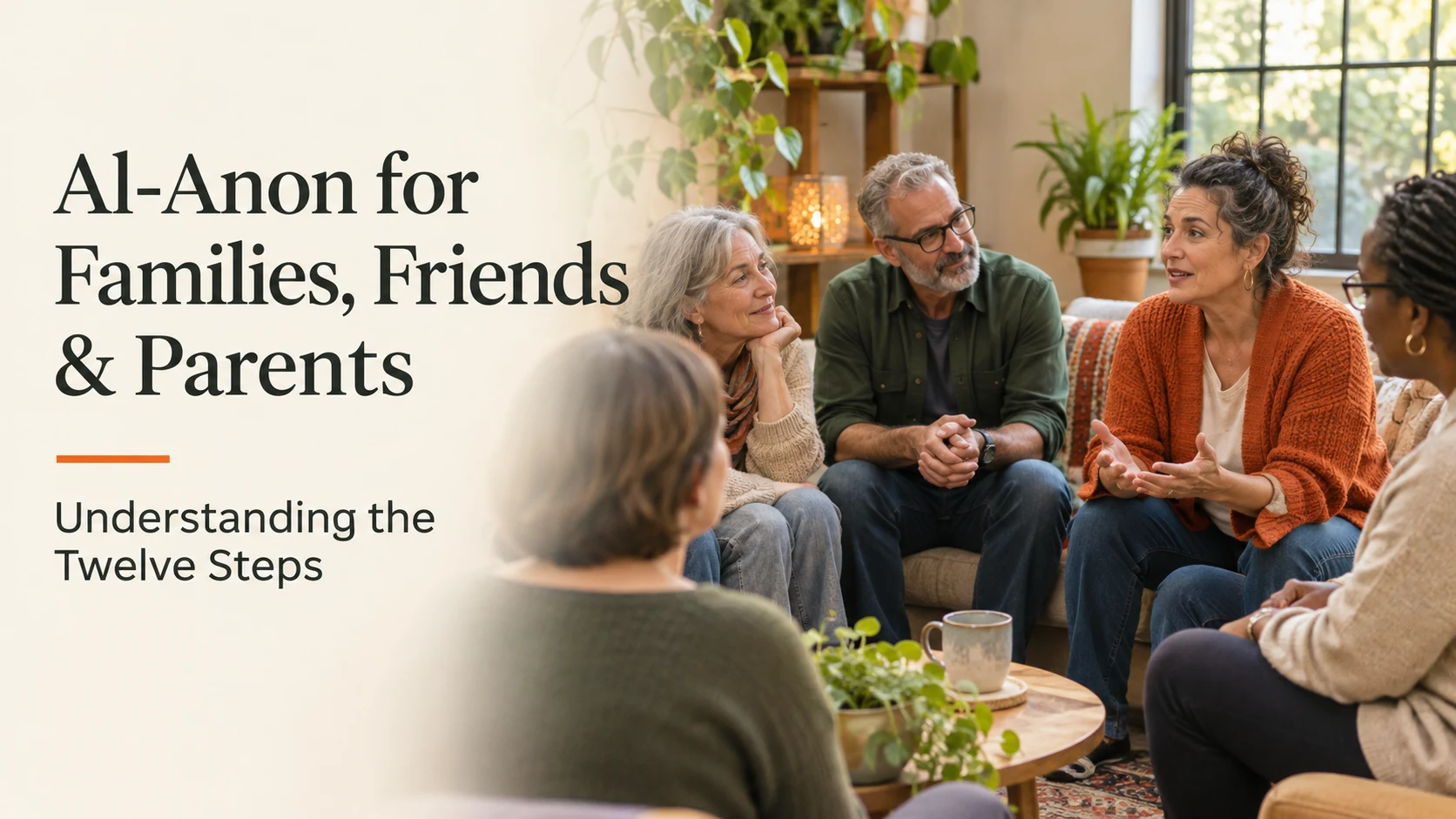
When someone you love keeps drinking, your own life can begin to revolve around alcohol without you taking a single drink. You may spend evenings waiting for a call, mornings checking whether they made it to work, and family gatherings trying to keep everyone calm. Parents may wonder what they missed. Partners may feel responsible for holding the household together. Friends may be unsure whether speaking up will end the friendship.
Al-Anon offers a place to work on how someone else’s drinking has affected you. It is a peer-support fellowship for relatives and friends, with a Twelve Step approach focused on members’ own recovery. You can explore support even if your loved one denies the problem or refuses treatment. This guide explains how the program works, what its Steps can mean in everyday family life, and when additional professional help may be useful.
Key Points
- Al-Anon is for people affected by someone else’s drinking, including parents, partners, siblings, adult children, and friends.
- The Twelve Steps focus on your responses, relationships, and well-being. They are not a method for making another person stop drinking.
- You can care deeply, offer appropriate help, and set limits without taking responsibility for another adult’s recovery.
- Meetings and Step work can complement counseling and family support. They do not provide medical detox or emergency care.
- Parents of minors still need to arrange appropriate supervision, safety, and healthcare. Detachment does not cancel those responsibilities.
- You do not need to have the family’s entire situation figured out before attending a meeting.
Al-Anon at a Glance
| Question | What families should know |
|---|---|
| Who is it for? | Relatives and friends whose lives have been affected by someone’s drinking, whether that person is currently drinking or in recovery. |
| What is the focus? | Your own recovery: recognizing patterns, reducing isolation, examining your reactions, and building a more manageable life. |
| What happens in meetings? | Members share personal experience and listen to others. Formats vary; newcomers can listen without sharing. |
| What does it cost? | No membership dues or required fees. Groups are supported by voluntary contributions. |
| Does my loved one have to attend? | No. Your participation does not depend on their willingness to seek help. |
| Is it religious? | It is a spiritual program with references to God and a Higher Power in its Steps, but it is not affiliated with a particular religion. |
| What about teenagers? | Alateen offers peer support for young people affected by another person’s drinking. Check local meeting eligibility and arrangements. |
| Where can I start? | Use the official meeting directory to find an in-person, online, or telephone meeting. |
Program information: Al-Anon Family Group Headquarters, Inc. See the official meeting, newcomer, and Alateen resources in the references.
What Is Al-Anon, and Who Can It Help?
Al-Anon brings together people who recognize the strain of another person’s drinking. Its purpose is mutual support rather than diagnosing the person who drinks or telling a family which decisions to make. The program’s own newcomer information explains its approach and answers common questions about attending.
You do not have to be a spouse to belong. A mother worried about an adult son, a father of a teenager, a sibling tired of covering up missed commitments, and a friend who no longer knows how to respond can all have reasons to seek support. Nor do you have to prove that your situation is worse than anyone else’s.
A useful question is: How much of my life is being organized around this person’s drinking? Consider whether you have stopped sleeping well, abandoned friendships, repeatedly changed plans, or begun measuring every day by whether your loved one drank. These are reasons to pay attention to your own needs, regardless of whether the other person accepts a particular label.
For parents, that can be a difficult shift. Looking after yourself may feel disloyal when your child is struggling. But having a meal, attending your own appointment, or asking for support does not take care away from your child. It gives your needs a legitimate place in the conversation. Al-Anon also provides a resource specifically for parents concerned about a child’s drinking.
Al-Anon vs. AA, Alateen, and Professional Support
Several kinds of help can be useful at the same time. The right question is what each one is intended to do. Al-Anon addresses the experience of being affected by another person’s drinking; alcohol treatment addresses the drinking person’s clinical needs.
| Support | Primary focus | How it may fit |
|---|---|---|
| Al-Anon | Relatives and friends affected by someone else’s drinking. | Ongoing peer connection and personal Step work. |
| Alcoholics Anonymous (AA) | People seeking help with their own drinking. | A mutual-help option for the person who drinks. |
| Alateen | Young people affected by another person’s drinking. | Age-appropriate peer support; it is not treatment for a teen’s own alcohol use disorder. |
| Licensed counseling | Individual or family mental-health and relationship needs. | Assessment and treatment for concerns such as trauma, anxiety, or relationship distress. |
| Family consulting | Practical decisions, communication, boundaries, and coordination. | Help turning concerns into a specific family plan. |
| Alcohol treatment | The individual’s alcohol use disorder and related health needs. | Medical evaluation, behavioral treatment, medication when appropriate, and continuing care. |
The National Institute on Alcohol Abuse and Alcoholism describes both professional treatment and mutual-support options. Joining a support group does not require choosing against medical care or therapy.
The Twelve Steps Explained for Families, Friends, and Parents
The explanations below are original, plain-language commentary, followed by illustrative family examples. They are not the official wording of the Steps, an Al-Anon workbook, or instructions from Al-Anon. Read the official Twelve Steps alongside them. A sponsor and Al-Anon’s own literature can help you explore the program more fully and at your own pace.
Step 1: Recognize what you cannot control
Step One begins with acknowledging the limits of your power over alcohol and the disruption in your own life. That does not mean you are powerless to protect yourself, seek advice, or offer help. It means another person’s sobriety cannot be made certain by your vigilance.
Imagine a parent who spends every evening questioning an adult daughter about how much she drank. The conversations become arguments, and neither person sleeps. An initial change might be to stop the nightly interrogation and arrange a calmer conversation about concrete concerns and available help.
A reflection to try: Make two lists: what is within your responsibility, and what you have been trying to control. Your spending, your responses, and your appointments belong on the first list. Another adult’s decision to drink does not.
Step 2: Allow room for help beyond your own efforts
Step Two introduces hope through a power beyond oneself. In a family’s everyday life, one useful starting point is recognizing that repeating the same private struggle is not the only available option. The spiritual meaning is something members explore personally.
A friend might have become the only person who knows how serious the drinking has become. Every late-night call feels like a test of loyalty. Seeking their own support can interrupt the belief that they must always have the answer.
This is not a promise that a meeting will resolve a crisis or change someone else’s behavior. It is permission to consider a different source of perspective. A practical first move could be putting one meeting on the calendar and approaching it with curiosity rather than expecting an immediate solution.
Step 3: Practice releasing the need to direct everything
Step Three involves entrusting one’s life and will to God as personally understood. Its spiritual language should not be confused with surrendering judgment or handing authority over your decisions to another member.
For a partner, an everyday application might be making a considered plan and then resisting the impulse to keep renegotiating it whenever anxiety rises. You can arrange a safe ride, explain what you will do, and seek qualified advice without trying to script every response your loved one gives.
A reflection to try: Before sending a fifth message, ask, “Is there a necessary action here, or am I trying to eliminate uncertainty?” A pause can help separate a useful action from an attempt to obtain reassurance. Immediate safety concerns still require action.
Step 4: Look honestly at your own patterns
Step Four asks for an honest personal inventory. The subject is your behavior and inner life, not a new catalogue of everything the drinking person has done. Accountability is different from deciding that you caused their alcohol problem.
For example, a parent might notice a pattern of making financial promises in moments of panic and resenting them later. A sibling might see that sarcasm has replaced direct conversation. A partner might realize they have stopped acknowledging their own exhaustion.
Writing down the situation, your feelings, what you did, and what you wish you had done can make a pattern clearer. Include strengths as well as difficulties. Being frightened, hurt, or subjected to abuse is not a moral failure, and an inventory should never turn someone else’s harmful behavior into your fault.
Step 5: Bring honesty into a trusted conversation
Step Five takes the inventory beyond private reflection through acknowledgment to oneself, a Higher Power, and another person. The aim is honest disclosure, not a public performance or a demand to reveal intimate details to everyone.
A family member might say to a trusted sponsor, “I tell everyone I am fine, but I am angry that I keep paying bills I cannot afford.” Naming that conflict can be more useful than continuing to act as though the arrangement is sustainable.
Choose carefully whom you trust and how much you are ready to discuss. A sponsor’s role is peer support; it does not replace a licensed professional’s work with trauma, mental-health symptoms, or safety. You can be honest about your own actions without accepting blame for someone else’s drinking.
Step 6: Become willing to change familiar responses
Step Six concerns readiness to let go of personal patterns that are causing harm. Recognizing a pattern and being willing to change it are different experiences. A response can feel protective even when it repeatedly leaves you depleted.
Consider a friend who always explains away canceled plans. They may fear that saying what happened will be disloyal. Willingness could begin with deciding to stop inventing excuses while still protecting the person’s privacy: “They cannot make it today” is different from constructing a false story.
You do not have to replace every familiar response at once. Identify one behavior you are prepared to reconsider and the fear that makes it hard to change. The work is about your choices; it is not about becoming flawless enough to earn another person’s recovery.
Step 7: Ask for help and practice a different response
Step Seven brings humility and a request for spiritual help into the process of change. Humility here need not mean thinking less of yourself. It can mean recognizing that knowledge alone has not made a difficult habit disappear.
A parent who knows that shouting is unhelpful may still shout when frightened. A practical experiment is to prepare one sentence before a difficult discussion: “I want to talk about this, and I need ten minutes so I can do that calmly.” Asking a trusted support person to help you rehearse can make the sentence easier to use.
Notice the difference between requesting support and asking someone to make the decision for you. You remain responsible for the limits you choose, the help you offer, and whether a situation requires professional involvement.
Step 8: Identify harm you can take responsibility for
Step Eight involves recognizing people harmed by your actions and developing willingness to make amends. It is preparation, not a requirement to rush into every difficult conversation immediately.
A parent might recognize that an unaffected child has repeatedly been asked to stay quiet or give up plans because the family is managing another crisis. A spouse might recognize that they disclosed private information in anger. Those actions can be addressed without taking responsibility for the drinking itself.
Be specific about the action and its effect. “I repeatedly canceled our time together without listening to you” is more workable than “I ruined everything.” Avoid assigning yourself responsibility for harm done to you. If fear or coercion makes accountability confusing, bring that concern to an appropriately qualified professional.
Step 9: Make amends without creating more harm
Step Nine moves toward repair when doing so will not injure the person involved or others. An apology is not automatically helpful just because the speaker wants relief. Timing, safety, privacy, and the other person’s wishes matter.
For a parent, amends might include apologizing to another child for repeatedly overlooking them and then protecting regular time together. For a friend, it might mean acknowledging a cruel remark without adding an argument about why the drinking person deserved it.
Repair does not require withdrawing a reasonable boundary, resuming an unsafe relationship, or demanding forgiveness. Changed conduct can matter more than a dramatic conversation. If contact would violate a safety plan or legal restriction, do not make contact to complete a Step; seek appropriate guidance.
Step 10: Notice patterns before they build again
Step Ten makes personal inventory ongoing rather than a one-time task. Recognizing a mistake sooner can make it easier to address without allowing another week of resentment to accumulate.
You might realize that you agreed to provide money because you wanted a difficult call to end. Rather than treating that moment as proof you have failed, you can examine it, clarify what you can realistically offer, and prepare for the next request.
A short evening check-in can help: What did I do from fear? Where did I communicate clearly? Is there something I need to correct? Keep the review proportionate. Constantly monitoring yourself for faults can become another exhausting habit; the aim is useful awareness and timely repair.
Step 11: Make space for reflection and spiritual connection
Step Eleven centers prayer and meditation as ways to strengthen spiritual connection and seek guidance. Members approach the program’s spiritual language through their own understanding; this article does not prescribe a belief.
In a busy family, protected quiet time may be unfamiliar. A person who wakes up and immediately checks messages about their loved one might experiment with a few minutes of reflection first, when no urgent situation requires attention.
The practical question is whether you have any space to notice your own needs before responding to everyone else’s. Reflection can support deliberate choices, but it should not be presented as a substitute for treatment of anxiety, depression, trauma, or other health concerns. Seeking professional help and maintaining a spiritual practice can coexist.
Step 12: Carry what you have learned into everyday life
Step Twelve connects spiritual growth with helping others and practicing the principles throughout life. That is broader than managing conversations about alcohol. It can affect how you listen, handle disagreement, and recognize your limits elsewhere.
A member might welcome a newcomer or share an experience without insisting that the other person make the same choices. At home, a parent might begin asking what support someone wants before deciding what they need.
Service should not become another version of rescuing everyone. You can be helpful without being constantly available, and you do not need to prove your progress by persuading your loved one to change. A useful measure is whether you are living with greater honesty, steadier limits, and more room for your own life.
Boundaries and Detachment Without Abandonment
Al-Anon’s Detachment leaflet describes separating yourself from the damaging effects of another person’s drinking while still caring about the person. Detachment is not punishment, a way to manufacture a crisis, or a reason to ignore danger.
A boundary describes your response to a situation. “You must stop drinking” expresses a desired outcome. “I will not ride in a car when you have been drinking” identifies what you will do. The second statement can be followed through regardless of whether the other person agrees.
- Money: “I cannot provide cash. I can discuss helping arrange an assessment.”
- Communication: “I will pause the conversation if we start insulting each other. We can try again when we are calmer.”
- Social plans: “I would like to spend time together in a setting that does not revolve around drinking.”
- Your own support: “I am going to keep my counseling appointment, even though things are unsettled.”
These are examples to adapt, not universal rules. Dependents, housing, medical needs, finances, and safety can make a decision more complicated. The Firm’s family consulting services can help families discuss realistic limits and agree on how to communicate them.
What Parents Should Know About Teens and Adult Children
Parents may need two plans at once: one for their child’s needs and another for their own support. Those plans will look different for a 14-year-old and a financially independent adult. A minor still needs age-appropriate supervision, protection, and access to healthcare. Applying an adult example of “letting go” without considering those responsibilities can be unsafe.
If you are concerned about a teenager’s own drinking, arrange an assessment with an appropriate healthcare professional. Alateen is for young people affected by someone else’s drinking; it should not be mistaken for treatment of their own alcohol use. Siblings who are living with the strain may also need support. The official Alateen information explains its purpose.
With adult children, clarify what you are actually being asked to provide. Paying a bill, arranging transportation, offering a place to stay, and finding treatment are different decisions. Avoid making a large promise simply to end a frightening phone call. When it is safe to pause, take time to understand the request and your capacity.
Parents looking for help with those decisions can start with The Firm’s guide for parents of an adult child with addiction. You can seek your own support while continuing to offer your child a path toward appropriate care.
How to Attend Your First Al-Anon Meeting
Start with the official Al-Anon meeting directory, which includes in-person and electronic options. Check the time zone, access details, and any group information. If a listing leaves you uncertain, use its contact information to ask before attending.
You can listen at your first meeting. You do not need to arrive with a diagnosis, a polished account of the family history, or a decision about working every Step. Al-Anon recommends trying several different meetings because groups vary. Its guidance specifically suggests six before deciding whether the program is helpful.
Members are asked to respect anonymity. For an online meeting, choose a private place, use headphones when helpful, and avoid recording or sharing identifying details. Anonymity is a shared practice; it is not the same as the confidentiality protections of a clinical treatment relationship.
Afterward, consider a few simple questions: Did I feel able to listen? Did anything help me understand my own situation? Would I like to try another meeting? You do not need to assess the whole program from one evening.
When Your Family Needs More Than a Support Meeting
Peer support and practical intervention planning address different needs. A family may value meetings while still needing help with treatment refusal, repeated crises, or choosing appropriate care. Professional evaluation is especially important when drinking is accompanied by medical symptoms or serious mental-health concerns.
Heavy, prolonged drinking can lead to dangerous withdrawal when alcohol is stopped or sharply reduced. Families should seek medical guidance rather than supervise a home detox. A seizure, severe confusion, trouble breathing, or inability to wake the person requires emergency medical help: call 911 in the United States. A support meeting is not an emergency service. See the ASAM withdrawal guideline and NIAAA’s alcohol-overdose guidance.
For non-emergency planning, The Firm can discuss alcohol intervention, family consulting, and treatment placement guidance. These services can help organize what has happened, clarify what the family is offering, and prepare for different responses. They do not guarantee that someone will accept treatment.
You do not have to wait for your loved one to agree before seeking support for yourself. If your family needs help deciding what to do next, contact The Firm or call 877-FIRM-910. The Firm is independent of Al-Anon and is not endorsed by or affiliated with Al-Anon Family Groups.
Frequently Asked Questions About Al-Anon
Can I attend Al-Anon if my loved one refuses to stop drinking?
Yes. Al-Anon is intended to support you in dealing with the effects of another person’s drinking. Their participation in treatment or acknowledgment of the problem is not a condition of your attendance.
Is Al-Anon appropriate for friends as well as family?
Yes. Friends can be affected by someone’s drinking and are included in the fellowship’s purpose. You do not need to be related, married, or living together.
Does working the Steps mean I caused the drinking problem?
No. Examining your behavior means looking at what you can change in your own life. It does not make you responsible for another person’s alcohol use disorder or require you to excuse harm done to you.
Do I have to be religious to attend?
Al-Anon is not affiliated with a particular religion, and people with different beliefs or no religious affiliation attend. Its Steps use spiritual language, including God and a Higher Power. You can explore whether that approach fits you without pretending to hold beliefs you do not have.
How long does it take to work through the Twelve Steps?
There is no single timetable that fits everyone. Step work involves reflection and practice rather than finishing twelve assignments as quickly as possible. Discuss pace and questions with a sponsor or experienced member, and use the program’s own literature.
Does detachment mean cutting off my child?
No. Detachment is not a universal instruction to stop contact or withdraw support. It means reconsidering your involvement in harmful patterns. Safety, the person’s age, dependency, and your responsibilities matter when deciding what a reasonable boundary looks like.
Can I go to Al-Anon and therapy at the same time?
Yes. Peer support and professional counseling serve different purposes and can be used together. A meeting or sponsor should not replace evaluation or treatment for a mental-health condition.
Will Al-Anon help me get my loved one into treatment?
Its focus is your own recovery, not a guaranteed method of securing someone else’s treatment participation. If your family needs a specific plan for discussing treatment or responding to refusal, that is a separate question to bring to an appropriately qualified professional.
References
Al-Anon Family Group Headquarters, Inc. (n.d.-a). Al-Anon meetings. https://al-anon.org/al-anon-meetings/
Al-Anon Family Group Headquarters, Inc. (n.d.-b). Alcoholic child. https://al-anon.org/newcomers/how-can-i-help-my/alcoholic-child/
Al-Anon Family Group Headquarters, Inc. (n.d.-c). Detachment [Brochure]. https://al-anon.org/pdf/S19.pdf
Al-Anon Family Group Headquarters, Inc. (n.d.-d). FAQ. https://al-anon.org/newcomers/faq/
Al-Anon Family Group Headquarters, Inc. (n.d.-e). Step eight. https://al-anon.org/blog/step-eight/
Al-Anon Family Group Headquarters, Inc. (n.d.-f). Step eleven. https://al-anon.org/blog/step-eleven/
Al-Anon Family Group Headquarters, Inc. (n.d.-g). Step five. https://al-anon.org/blog/step-five/
Al-Anon Family Group Headquarters, Inc. (n.d.-h). Step four. https://al-anon.org/blog/step-four/
Al-Anon Family Group Headquarters, Inc. (n.d.-i). Step nine. https://al-anon.org/blog/step-nine/
Al-Anon Family Group Headquarters, Inc. (n.d.-j). Step one. https://al-anon.org/blog/step-one/
Al-Anon Family Group Headquarters, Inc. (n.d.-k). Step seven. https://al-anon.org/blog/step-seven/
Al-Anon Family Group Headquarters, Inc. (n.d.-l). Step six. https://al-anon.org/blog/step-six/
Al-Anon Family Group Headquarters, Inc. (n.d.-m). Step ten. https://al-anon.org/blog/step-ten/
Al-Anon Family Group Headquarters, Inc. (n.d.-n). Step three. https://al-anon.org/blog/step-three/
Al-Anon Family Group Headquarters, Inc. (n.d.-o). Step twelve. https://al-anon.org/blog/step-twelve/
Al-Anon Family Group Headquarters, Inc. (n.d.-p). Step two. https://al-anon.org/blog/step-two/
Al-Anon Family Group Headquarters, Inc. (n.d.-q). Teen corner (Alateen). https://al-anon.org/newcomers/teen-corner-alateen/
Al-Anon Family Group Headquarters, Inc. (n.d.-r). The Twelve Steps. https://al-anon.org/for-members/the-legacies/the-twelve-steps/
American Society of Addiction Medicine. (2020). The ASAM clinical practice guideline on alcohol withdrawal management. https://www.asam.org/quality-care/clinical-guidelines/alcohol-withdrawal-management-guideline
National Institute on Alcohol Abuse and Alcoholism. (n.d.-a). Treatment for alcohol problems: Finding and getting help. National Institutes of Health. https://www.niaaa.nih.gov/publications/brochures-and-fact-sheets/treatment-alcohol-problems-finding-and-getting-help
National Institute on Alcohol Abuse and Alcoholism. (n.d.-b). Understanding the dangers of alcohol overdose. National Institutes of Health. https://www.niaaa.nih.gov/publications/brochures-and-fact-sheets/understanding-dangers-of-alcohol-overdose
Educational information from The Firm Addiction Consulting. The family examples are illustrative, not client stories or official Al-Anon guidance.